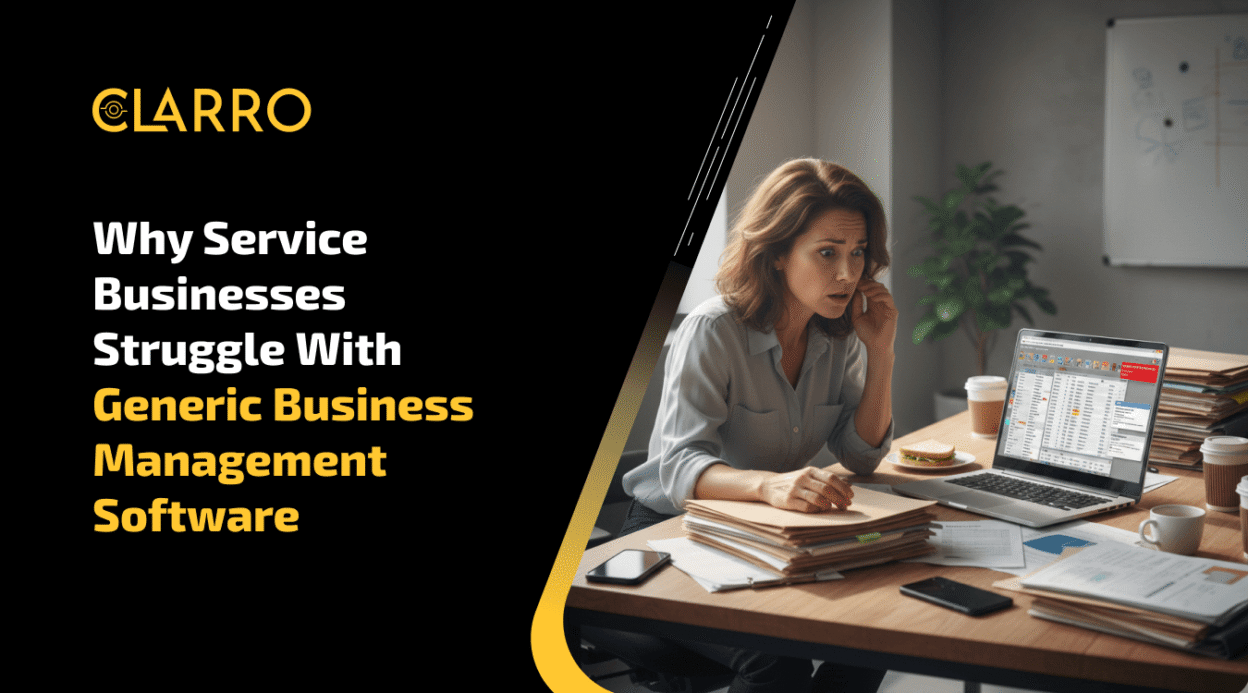
Business Management Software has become essential for how service businesses operate today. From managing clients and schedules to handling billing, reporting, and daily operations, software now plays a direct role in productivity, service quality, and profitability. As customer expectations rise and operations grow more complex, many service businesses turn to online business management software to streamline their workflows and stay competitive.
However, not all software delivers on that promise. While generic business software is often marketed as an easy, all-purpose solution, it is rarely designed for the real-world needs of service-based companies. These tools are designed to serve multiple industries simultaneously, which means that critical service workflows, such as flexible scheduling, client management, and service-based billing, are often oversimplified or missing entirely.
As a result, service businesses frequently struggle with rigid systems, manual workarounds, disconnected tools, and limited visibility into performance. Instead of supporting growth, generic software can slow teams down and create hidden operational costs.
In this blog, we’ll explore why many service businesses face these challenges, how generic tools often fall short in practice, and why selecting the right comprehensive business management software is crucial for achieving sustainable growth and long-term success.
What Is Generic Business Software?
Generic business software refers to off-the-shelf tools created to serve a wide range of industries with the same core features. Instead of being designed around specific business models, these platforms offer standardized functionality meant to “work for everyone.” For service businesses, this often means adapting internal processes to fit the software, rather than the software supporting how the business actually operates.

These tools typically focus on broad operational needs such as task tracking, basic customer management, and reporting. Common examples include:
- Basic CRM platformsare designed for general sales tracking
- Generic project management tools built for linear workflows
- Spreadsheet-based systems are used to manage operations manually
- Large all-in-one software suites that attempt to cover multiple functions at once
At first glance, generic tools appear attractive, especially to small and growing companies looking for quick solutions. Many service businesses adopt them because they offer clear short-term benefits, such as:
- Fast setup and ease of use, with minimal onboarding
- Lower upfront costs compared to custom or industry-specific solutions
- Cloud-based access makes them a popular form of online business management software
- Wide feature coverage, even if those features aren’t fully relevant
However, these advantages often come with hidden trade-offs. Because generic platforms are not built around service workflows, they struggle to handle the realities of service delivery, such as flexible scheduling, recurring services, variable pricing models, and client-specific reporting. Over time, businesses begin to rely on manual workarounds, disconnected tools, and external integrations just to keep operations running smoothly.
What starts as a simple, cost-effective choice can quickly turn into a limiting factor. This is why many service companies eventually realize that generic business software may support basic operations, but falls short when it comes to efficiency, scalability, and long-term growth through effective Business Management Software.
The Root Problem: One-Size-Fits-All vs Tailored Workflows
Service businesses operate on workflows that are fundamentally different from product-based companies. Each service industry, whether consulting, digital agencies, or field services, has its own way of managing clients, delivering work, and generating revenue. However, most generic Business Management Software platforms are designed around standardized processes that assume predictability and uniformity. This mismatch is where problems begin.
Unlike traditional businesses, service operations are fluid. Project scopes change, timelines shift, billing structures vary, and client interactions evolve throughout the engagement. A consulting firm may manage long-term retainers, an agency may bill by milestones and deliverables, while a field service company must coordinate technicians, locations, and real-time scheduling. Generic software rarely accounts for these nuances.
For a deeper dive into how service-specific software handles these complexities, read the full guide to field service management software for service businesses.
How Generic Software Assumes vs How Service Businesses Operate
| Generic Software Assumptions | Real Service Business Needs |
| Fixed workflows | Flexible, evolving processes |
| Single billing method | Hybrid billing (hourly + milestone + recurring) |
| Linear project timelines | Overlapping and dynamic schedules |
| Basic client records | Detailed client history and engagement tracking |
A common example is billing. Many service businesses use a mix of hourly rates, milestone payments, retainers, and recurring fees within the same project. Generic systems often force teams to choose one billing structure, leading to inaccurate invoicing and revenue tracking. To compensate, teams rely on spreadsheets or third-party tools, creating fragmentation and inefficiency.
The Cost of Forced Workarounds
When software doesn’t align with workflows, employees adapt by creating manual processes. Over time, this results in:
- Repetitive data entry across disconnected tools
- Increased errors in scheduling, billing, and reporting
- Poor visibility into project progress and profitability
- Frustrated teams are spending more time managing software than serving clients
For small teams, these inefficiencies are especially damaging. Management software for small businesses should simplify operations, not introduce complexity. Instead, rigid systems reduce daily productivity and limit the ability to respond quickly to client needs.
Why This Limits Growth
As service businesses grow, their workflows become more complex, not more standardized. New services, clients, and teams require adaptable systems that scale with operations. Generic software, however, remains rigid. This lack of flexibility slows decision-making, restricts process improvement, and ultimately becomes a barrier to sustainable growth.
Choosing Business Management Software that aligns with service-specific workflows is not just an operational decision; it’s a strategic one that directly impacts efficiency, scalability, and long-term success.
Poor System Integration Creates Data Silos
Most service businesses rely on multiple software tools to manage their day-to-day operations. A typical setup includes a CRM for client information, a calendar or scheduling tool, project management software to track work, billing or invoicing platforms for revenue, and payroll systems for employees or contractors. Each tool serves a specific purpose—but when these systems don’t communicate with one another, operational complexity increases rapidly.
This fragmented setup is especially common among small and mid-sized service companies that adopt tools incrementally as they grow. While each solution may work well on its own, generic business software often lacks strong integration capabilities that allow data to flow seamlessly between platforms. As a result, information becomes trapped in isolated systems, creating what’s known as data silos.
How Data Silos Affect Daily Operations
When systems aren’t connected, teams are forced to manually move information between tools. Client details entered into a CRM may need to be re-entered into billing software. Project updates may live in one platform, while time tracking exists in another. Over time, this leads to several operational challenges:
- Duplicate data entry, increasing administrative workload
- Inconsistent or outdated information across systems
- Higher risk of errors, especially in billing and reporting
- Reduced visibility into overall business performance
According to research by McKinsey, employees spend nearly 20% of their work week searching for internal information or tracking down colleagues who can help with specific tasks. For service businesses, this translates directly into lost productivity and increased operational costs.
Reporting Confusion and Delayed Decisions
One of the biggest consequences of poor integration is unreliable reporting. When data is scattered across platforms, generating accurate insights becomes difficult. Business owners struggle to answer critical questions such as:
- Which services are most profitable?
- How efficiently are teams utilizing their time?
- Which clients generate the highest lifetime value?
Instead of real-time insights, leaders rely on exported spreadsheets, manual reconciliation, and delayed reports. This slows decision-making and limits a company’s ability to respond quickly to operational or financial challenges, an especially serious issue for growing service businesses.
The Advantage of Integrated Online Business Management Software
In contrast, integrated online business management software connects workflows across departments. Client data, scheduling, billing, project tracking, and reporting operate within a unified system. Information is entered once and updated everywhere, reducing errors and improving transparency.
For service businesses, this integration supports faster decision-making, clearer reporting, and smoother collaboration. Rather than managing disconnected tools, teams can focus on delivering high-quality services and scaling efficiently—making integration a critical factor when choosing the right Business Management Software.
Scalability Problems: When Growth Outpaces Generic Tools
Many small service businesses initially adopt generic business software because it’s easy to set up and cost-effective. These tools handle basic operations like scheduling, billing, and client management without extensive customization. However, as the business grows, the very platforms that once seemed sufficient often become a limiting factor.
Why Growth Exposes Limitations
As service businesses expand, their operational complexity increases. More clients, larger teams, and a growing volume of projects introduce demands that generic software struggles to meet:
- User limits: Many off-the-shelf platforms restrict the number of active users, forcing businesses to pay for higher tiers or adopt new systems entirely.
- Data volume: Generic software is often optimized for small datasets. As projects, client histories, and billing records accumulate, performance can slow significantly.
- Reporting needs: Early-stage businesses may only require basic dashboards, but scaling operations demands detailed, customizable reports to track profitability, resource utilization, and service performance.
These limitations often lead to performance slowdowns, forced upgrades, or even costly system replatforming, situations that disrupt operations and divert resources from growth initiatives.
The Challenge for Small Businesses
Even software branded as management software for small businesses can quickly become insufficient. The evolving business logic of a service company, flexible billing models, multi-location scheduling, and cross-functional teams require adaptability that generic tools cannot provide. Teams may resort to workarounds, such as exporting data to spreadsheets, using multiple disconnected tools, or manually reconciling reports. While these methods temporarily patch gaps, they reduce efficiency, increase errors, and undermine scalability.
For contractors and field service teams specifically, specialized tools like HVAC service software for contractors can address these unique operational challenges by providing industry-specific features that generic platforms simply cannot match.
Why Scalability Matters
For growing service businesses, scalability is more than just handling more users or projects; it’s about supporting complex workflows without friction. A platform that cannot evolve alongside the business introduces hidden costs: wasted employee hours, delayed client deliveries, and missed growth opportunities. Choosing scalable Business Management Software ensures that as the company grows, the software continues to support productivity, automation, and insight-driven decision-making, rather than holding the business back.
In short, generic software may meet immediate needs, but when service businesses outgrow its capabilities, growth becomes constrained, operational efficiency suffers, and strategic goals are harder to achieve. Investing in scalable, adaptable software is essential for sustainable expansion.
Limited Reporting & Insight Capabilities
For service businesses, accurate and actionable data is the foundation of informed decision-making. Detailed reporting enables managers to track profitability, monitor resource allocation, and analyze client history, providing the insights needed to optimize operations and identify growth opportunities. Without this, businesses are forced to make decisions based on assumptions, which can lead to lost revenue and inefficiencies.
Most generic business software provides only surface-level reporting. Standard dashboards might show overall project completion or revenue totals, but rarely allow customization or deep analysis. For example:
- A basic CRM might list client projects, but cannot show profitability per service type.
- Standard project management tools track hours worked but cannot reveal inefficiencies across multiple teams or projects.
These limitations are particularly harmful for service businesses, where margins are tightly measured, and labour costs often account for a large portion of expenses. Inaccurate or poor‑quality operational data can be costly: studies estimate that bad data can cost businesses between 15% to 25% of their annual revenue due to error correction, inefficiencies, and flawed decision‑making. (source:-gitnux)
By contrast, integrated online business management software centralizes data across all workflows, billing, scheduling, project tracking, and client management. Customizable dashboards give real-time insights, helping businesses identify underperforming services, optimize resource allocation, and make data-driven decisions that directly impact growth and profitability.
Hidden Costs of Generic Business Software
At first glance, generic software appears affordable. However, the true cost extends far beyond the initial subscription. One of the biggest hidden expenses is the time employees spend on manual workarounds, re-entering data between tools, reconciling inconsistent reports, or managing disconnected systems with spreadsheets.

Additionally, many generic tools require upgrades or add-ons to access essential features. While the base price may seem low, businesses often spend more on premium tiers for reporting, integrations, or advanced scheduling. A 2023 survey by Software Advice found that over 60% of small businesses spend more on add-ons than on their core software license.
The total cost of ownership (TCO) includes not just subscription fees, but lost productivity, operational inefficiencies, and error correction. For small service businesses, investing in generic software that doesn’t align with workflows can lead to wasted time, frustrated teams, and underutilized features.
Choosing scalable, integrated Business Management Software designed for service workflows avoids these hidden costs. Every feature supports real business needs, improving efficiency and ROI while freeing teams to focus on client service and growth. Investing in the right software from the start is not just cost-effective, it’s a strategic decision that pays dividends in long-term success.
Customer & Client Experience Gaps
For service businesses, customer satisfaction is directly tied to operational efficiency. Clients expect timely updates, accurate billing, transparent communication, and seamless service delivery. When these expectations aren’t met, client trust and loyalty can quickly erode, affecting repeat business and long-term growth.
Unfortunately, generic business software often fails to support these critical aspects of the client experience. Many off-the-shelf tools provide minimal client-facing features, such as basic portals or static reports, and lack robust customer engagement tools. This leads to several common challenges:
- Limited visibility: Clients cannot easily track project progress or access invoices, requiring manual updates from staff.
- Communication gaps: Generic systems rarely support automated notifications, real-time updates, or messaging between teams and clients.
- Error-prone processes: Fragmented data across multiple systems can result in billing mistakes, scheduling conflicts, or delayed responses.
These gaps not only increase internal workload but also directly impact client satisfaction. According to a 2022 report by HubSpot, over 60% of customers expect timely, transparent communication, yet many service businesses using generic software fail to meet this expectation due to system limitations.
The Solution: Integrated Online Business Management Software
Integrated online business management software addresses these challenges by centralizing client information and offering interactive dashboards. Clients can view project progress, approve tasks, access invoices, and communicate directly with service teams, all in one platform.
Benefits include:
- Improved transparency: Clients see real-time updates, which reduces confusion and builds trust.
- Faster communication: Automated notifications and messaging keep clients informed without manual effort.
- Enhanced retention: A smooth, professional experience increases satisfaction and loyalty, encouraging repeat business.
By providing a platform that supports client engagement, service businesses can transform operational efficiency into a competitive advantage. Unlike generic software, which often creates fragmented client experiences, tailored business management solutions ensure that every interaction strengthens relationships and drives long-term growth.
Better Alternatives: Specialized & Custom Solutions
For service businesses frustrated with the limitations of generic business software, specialized or custom solutions offer a more effective path. Unlike off-the-shelf tools, these platforms are designed with service-specific workflows in mind, providing functionality that aligns directly with how companies operate. Examples include field service management software for technicians, professional services automation (PSA) tools for consulting firms and agencies, and CRMs tailored for service industries.
Why Specialized Solutions Work Better
- Built-in Service Workflows
Tailored software comes with pre-configured workflows that match real-world service operations. Whether it’s scheduling field visits, managing recurring client projects, or handling milestone-based billing with payment processing & financial management features, these tools are designed to support the nuances of service delivery rather than forcing businesses to adapt to rigid, generic processes.
- Deep Customization
Custom solutions allow businesses to adjust features and workflows according to their unique needs. From client onboarding processes to reporting formats and internal approvals, customizable booking templates and service automation ensure that the software works for the business, not the other way around. This eliminates the need for workarounds and disconnected tools.
- Strong Integrations
Unlike many generic business software platforms, specialized solutions integrate seamlessly with other critical tools, including accounting systems, payroll platforms, marketing tools, and communication apps. This creates a unified ecosystem where data flows freely, reducing manual entry, improving accuracy, and enabling faster decision-making.
- Scalable Analytics
Service businesses need insight into profitability, resource utilization, and client performance. Tailored solutions offer advanced reporting and analytics dashboards that scale as the business grows, providing the visibility necessary to optimize operations and drive strategic decisions.
When Custom Software Is Worth the Investment
Investing in specialized or custom Business Management Software is particularly valuable when a service business has outgrown generic tools, struggles with inefficiencies, or needs to scale rapidly. While upfront costs are higher than generic solutions, the return on investment often comes in the form of reduced manual work, fewer errors, faster decision-making, and improved client satisfaction.
At Clarro, we specialize in designing custom management solutions for service businesses. Our all-in-one business operations platform focuses on understanding the unique workflows, reporting needs, and integration requirements of each client. We offer industry-specific use cases for service businesses to ensure that your team can work more efficiently, deliver better client experiences, and scale without being constrained by the limitations of generic tools.
Choosing a solution that aligns with your business logic is not just a technology upgrade; it’s a strategic decision that supports growth, profitability, and long-term operational success.
Conclusion:
Selecting the right Business Management Software is crucial for service businesses aiming to scale efficiently. While generic business software may seem easy and affordable, it often falls short, offering limited reporting, poor integration, rigid workflows, and scalability challenges that slow productivity and impact client satisfaction.
In contrast, tailored online business management software aligns with real service workflows. From customizable dashboards and seamless integrations to scalable analytics, specialized solutions help businesses operate smoothly, make informed decisions, and enhance the client experience.
The key is to evaluate your business needs carefully. Compare alternatives, consider the limitations of generic tools, and prioritize flexibility and adaptability over one-size-fits-all platforms. The right software reduces friction, saves time, and supports growth, transforming technology from a basic tool into a strategic partner for long-term success.
Related Resources:
Looking to dive deeper into service business software solutions? Check out these comprehensive guides:
Discover the best field service software to streamline and grow your service business – Learn about comprehensive solutions that integrate every aspect of your service operations into one powerful platform.
FAQs:
1. What is the difference between generic business software and tailored solutions?
Generic software is built for broad use across industries and often lacks features specific to service businesses. Tailored solutions are designed for service workflows, offering flexible scheduling, hybrid billing, integrated reporting, and better client management.
2. Why do service businesses struggle with online business management software?
Many service businesses start with generic tools that cannot handle complex workflows, multiple billing models, or growing teams. This leads to inefficiencies, data silos, and limited reporting that hinder productivity and growth.
3. How can tailored software improve client experience?
Specialized software provides client dashboards, real-time updates, automated notifications, and accurate billing. This transparency and seamless communication improve client satisfaction, loyalty, and retention.
4. Is custom business management software worth the investment for small businesses?
Yes. While upfront costs may be higher, tailored software reduces manual work, prevents errors, supports scalability, and delivers better ROI compared to generic platforms with hidden costs.
5. What should service businesses look for when choosing management software?
Prioritize flexibility, integration capabilities, scalability, and analytics. Ensure the platform supports your workflows, reduces manual processes, and provides real-time insights for informed decision-making.