The Software as a Service (SaaS) market isn’t just growing; it’s exploding. Projections show the market is set to soar past $883 billion in 2024 and is on a trajectory to break the trillion-dollar mark. For entrepreneurs and established businesses alike, this digital gold rush presents an unprecedented opportunity.
But with great opportunity comes great competition. The key to success isn’t just launching a SaaS product; it’s launching the right one—a product that solves a real, painful, and valuable problem.
Coming up with that killer idea is the first major hurdle. That’s why we’ve researched for you. At Clarro, we don’t just build software; we live and breathe product strategy. This article unveils 11 profitable SaaS application ideas poised for success in 2025, complete with the problems they solve and the markets they serve.
Let’s find your next big thing.
Why SaaS? The Unstoppable Shift from On-Premise Software
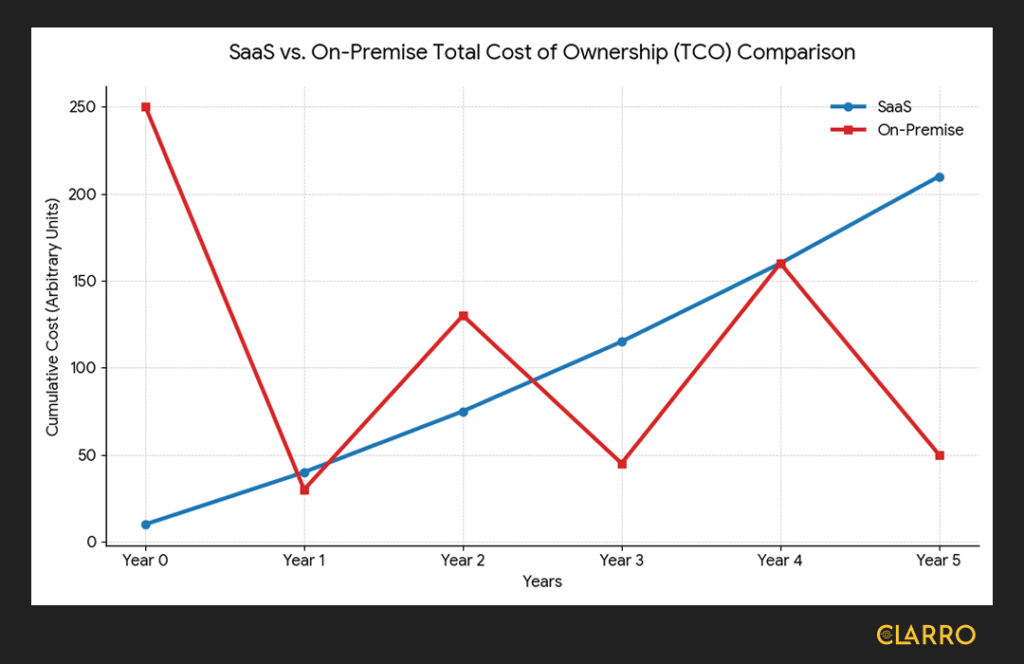
Before we dive into the ideas, it’s crucial to understand why the SaaS model is dominant. The days of buying software in a box and installing it on a single computer are fading fast. The SaaS vs. on-premise software comparison clearly illustrates why businesses are making the switch.
On-premise software requires massive upfront investment in licenses and hardware, dedicated IT staff for maintenance, and painful, manual updates. SaaS, on the other hand, offers a flexible, scalable, and cost-effective alternative.
SaaS vs. On-Premise: A Quick Comparison
| Feature | Software as a Service (SaaS) | On-Premise Software |
| Cost Model | Subscription-based (monthly/annual fee) | High upfront cost for perpetual license |
| Deployment | Hosted on the provider’s cloud servers | Installed on the user’s local servers |
| Accessibility | Accessible from any device with internet | Limited to specific devices or networks |
| Scalability | Easily scalable up or down as needed | Difficult and expensive to scale |
| Maintenance | Handled entirely by the provider | Managed by the user’s internal IT team |
| Updates | Automatic and seamless updates | Manual, often complex and costly updates |
This shift has created a fertile ground for innovation, allowing even small teams to develop and deploy powerful automation tools for small businesses and robust enterprise SaaS platforms for scaling.
11 Profitable SaaS Application Ideas for 2026
Here are 11 ideas, ranging from niche solutions to broad platforms, that tap into the most powerful trends of 2025: AI, hyper-automation, verticalization, and the creator economy.
1. AI-Powered Predictive Customer Churn Analytics
- The Problem: Customer acquisition is expensive. For subscription-based businesses, retaining existing customers is paramount. Yet, many companies are blindsided when a customer cancels, only reacting after the revenue is lost.
- The Solution: A SaaS platform that integrates with a company’s CRM (like Salesforce or HubSpot) and billing systems. It uses machine learning to analyze user behavior, support ticket history, product usage patterns, and payment data to assign a “churn risk score” to each customer. It can even send automated alerts to customer success teams to proactively engage at-risk accounts.
- Target Audience: Mid-to-large size SaaS companies, e-commerce stores with subscription models, and digital media companies.
- Clarro’s Take: Building a predictive AI engine requires specialized data science and backend engineering skills. Clarro’s product teams include experts who can architect these complex algorithms and integrate them seamlessly with third-party APIs.
2. Vertical SaaS for Skilled Trades (e.g., Electricians, Plumbers)
- The Problem: Skilled trade professionals are incredible at their craft, but often struggle with the administrative side of their business. They juggle scheduling, invoicing, customer communication, and inventory management using a messy combination of spreadsheets, text messages, and paper notebooks.
- The Solution: An all-in-one mobile-first platform designed specifically for one trade. For electricians, it could include features like a digital National Electrical Code (NEC) lookup, job scheduling with GPS tracking for technicians, on-site quote generation, and inventory management for common parts.
- Target Audience: Small-to-medium-sized electrical contracting businesses.
- Clarro’s Take: The key here is deep user research and a flawless mobile UI/UX. Our process always starts with a Discovery & Strategy phase to ensure the product we build is exactly what the target user needs and loves to use.
3. Centralized SaaS Subscription Management Software for SMBs
- The Problem: The average small business uses dozens of SaaS tools. This “SaaS sprawl” leads to redundant subscriptions, forgotten “shadow IT” expenses, and a huge administrative headache in managing billing and user access.
- The Solution: A dashboard that connects to a company’s financial accounts (via Plaid or similar APIs) to automatically detect all recurring software subscriptions. It provides a single view of total SaaS spend, identifies duplicate subscriptions, and allows administrators to manage user licenses and de-provision access for former employees with one click.
- Target Audience: Small to medium-sized businesses (10-250 employees) struggling with managing their tech stack.
- Clarro’s Take: This idea lives and dies by its integrations and security. Clarro has extensive experience building secure, scalable applications that connect with sensitive financial data, making us a trusted partner for this type of SaaS subscription management software.
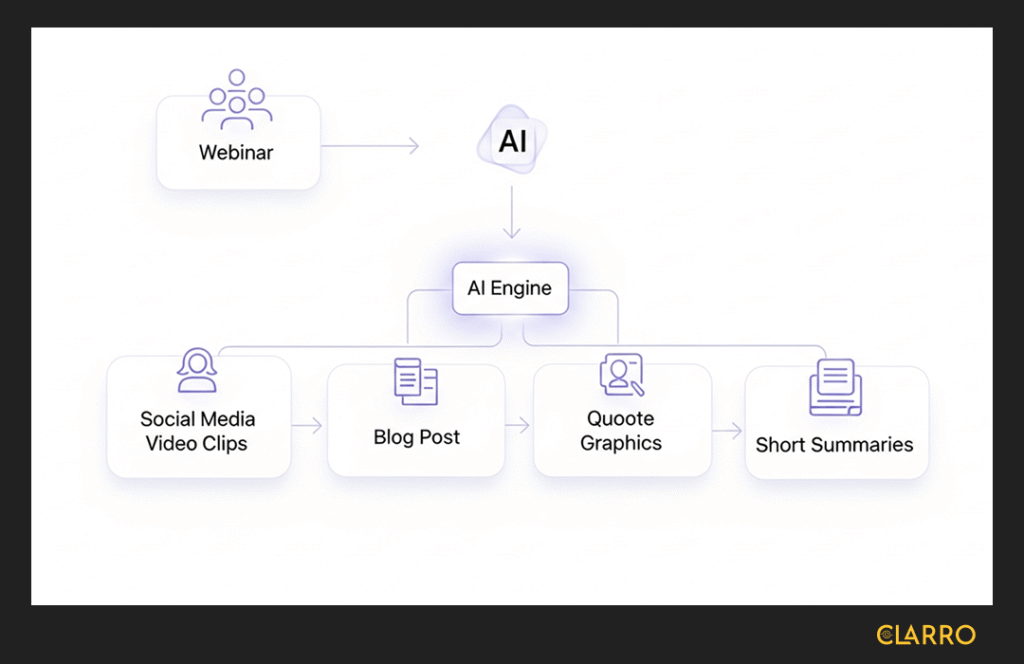
4. AI-Powered Content Repurposing & Distribution Engine
- The Problem: Content marketing is demanding. A company might spend days creating a single webinar or a long-form blog post, only for it to be seen once. Repurposing that content into different formats (social media clips, audiograms, quote cards, short articles) is effective but incredibly time-consuming.
- The Solution: A SaaS tool where a user can upload a long-form piece of content (video, audio, or text). The AI analyzes the content, identifies key moments or topics, and automatically generates dozens of assets: short video clips with captions for TikTok/Reels, key quotes formatted as images for Instagram/LinkedIn, a summary blog post, and a series of tweets.
- Target Audience: Marketing teams, content creators, and digital agencies.
5. ESG (Environmental, Social, Governance) Compliance & Reporting Platform
- The Problem: As investors and consumers demand greater corporate responsibility, companies are under increasing pressure to track and report on their ESG metrics. This data is often scattered across departments and is difficult to collect, standardize, and present in a compliant format.
- The Solution: A centralized platform that helps companies set ESG goals, collect data (e.g., energy consumption, diversity statistics, supply chain ethics), and automatically generate reports that align with major frameworks like GRI and SASB.
Target Audience: Mid-market and enterprise companies, particularly in manufacturing, retail, and finance.
6. Hyper-Personalized Corporate E-Learning Platform
- The Problem: Traditional corporate training is one-size-fits-all and often boring. Employees tune out, and the knowledge doesn’t stick. This results in wasted time and ineffective upskilling.
- The Solution: A learning management system (LMS) that uses AI to create personalized learning paths for each employee. It assesses their current skill level through a quick diagnostic and then recommends specific micro-learning modules, articles, and videos to fill their knowledge gaps. It adapts in real-time based on their performance.
- Target Audience: HR and Learning & Development departments in medium-to-enterprise level companies.
7. No-Code Internal Tool Builder for Operations Teams
- The Problem: Every business has unique internal workflows that off-the-shelf software can’t quite handle. Building custom internal tools requires expensive engineering time, creating a huge bottleneck for non-technical operations teams.
- The Solution: A drag-and-drop platform that allows operations managers to build their own simple applications without writing any code. They could create custom dashboards, approval workflows, data entry forms, and simple inventory trackers by connecting to data sources like Google Sheets, Airtable, or SQL databases.
- Target Audience: Operations, HR, and finance teams within tech-savvy but non-engineering-focused companies.
8. Financial Management & Forecasting Tool for the Creator Economy
- The Problem: Full-time creators (Youtubers, streamers, influencers) are running businesses, but their income is often volatile and comes from multiple, inconsistent sources (AdSense, brand deals, Patreon, merch). Traditional accounting software isn’t built for this reality.
- The Solution: A “QuickBooks for Creators.” This SaaS connects to all their income sources via API, tracks revenue, helps them manage uneven cash flow, projects future earnings based on historical data, and sets aside money for taxes.
- Target Audience: Professional content creators, influencers, and the agencies that manage them.
9. Mental Wellness & Burnout Prevention Platform for Remote Teams
- The Problem: In a remote or hybrid work environment, it’s difficult for managers to spot signs of burnout and stress in their teams. Employee well-being suffers, leading to decreased productivity and higher turnover.
- The Solution: A Slack/Teams-integrated platform that encourages mental wellness. It could include features like anonymized regular “pulse” surveys, guided meditation breaks, resources for mental health support, and AI-powered insights for managers that flag potential team-wide burnout risks without singling out individuals.
- Target Audience: People-first companies, HR departments, and managers of remote teams.
10. Automated Data Privacy & Compliance Manager (GDPR/CCPA)
- The Problem: Navigating data privacy regulations like GDPR and CCPA is a legal and technical nightmare. Many businesses don’t have the expertise to ensure their website, cookies, and data handling processes are compliant, exposing them to massive fines.
- The Solution: A SaaS tool that scans a company’s website and web applications to identify data privacy risks automatically. It can generate compliant privacy policies, manage cookie consent banners, and automate the process of handling user data deletion requests (“right to be forgotten”).
- Target Audience: Any online business that collects user data, especially those operating in Europe or California.
11. Smart API Integration & Workflow Automation Hub
- The Problem: Businesses rely on a suite of specialized SaaS tools that don’t talk to each other. This creates data silos and requires manual data entry between platforms, wasting time and causing errors. While tools like Zapier exist, they can become complex and expensive for multi-step, conditional logic.
- The Solution: A more advanced, developer-friendly automation platform focused on creating robust workflows between enterprise SaaS platforms for scaling. It would offer superior debugging tools, version control for workflows, and pre-built templates for complex processes like “When a new ‘Closed Won’ deal in Salesforce, create a customer in Stripe, provision a project in Asana, and send a welcome sequence via Intercom.”
- Target Audience: Tech-forward SMBs, operations teams, and enterprise companies with complex software stacks.
From Idea to Launch: How Clarro Transforms Your SaaS Vision into Reality
Having a great idea is only 10% of the journey. The other 90% is execution. This is where most aspiring SaaS founders get stuck. How do you validate the idea? What features go into the MVP? How do you build a scalable, secure, and beautiful product?
This is the problem Clarro solves. We provide a dedicated Product Team as a Service. Instead of you spending months and a fortune trying to hire a product manager, a UI/UX designer, and a team of senior developers, we provide a complete, cohesive team that works as an extension of your own.
Our process is designed to de-risk your investment and maximize your chances of success:
- Product Strategy & Discovery: We start by refining your vision, conducting market research, and defining a clear roadmap for your Minimum Viable Product (MVP).
- UI/UX Design: Our designers create intuitive, user-centric interfaces and prototypes that ensure your customers will love using your product from day one.
- Agile Development: Our expert developers build your application using modern, scalable technologies. We work in two-week sprints, giving you full transparency and regular deliverables.
- Launch & Scale: We don’t just build and leave. We help you launch, gather user feedback, and continue to iterate and scale your product to meet market demands.
Conclusion: Your Next Chapter Starts Now
The SaaS landscape in 2025 is ripe with opportunity for those willing to solve meaningful problems. Whether it’s through hyper-focused automation tools for small businesses or sophisticated enterprise SaaS platforms for scaling, the potential for impact and profit is enormous.
These 11 ideas are not just theoretical concepts; they are starting points for real businesses. The most critical step you can take is the next one: moving from ideation to action. With a validated idea and a world-class product team behind you, there’s no limit to what you can build.
FAQs:
1. What makes a SaaS application idea profitable in 2026?
A profitable SaaS idea solves a real pain point, targets a specific audience, and leverages emerging trends like AI, automation, or niche verticals. Subscription-based revenue, scalability, and ease of integration with other platforms also play a key role in long-term profitability.
2. How do I decide between building a SaaS vs. on-premise software?
SaaS is ideal if you want lower upfront costs, easy scalability, and cloud-based accessibility. On-premise software may be better for highly regulated industries needing full control over data. The choice depends on your target market, business model, and technical requirements.
3. Can small businesses succeed with a SaaS product, or is it only for large enterprises?
Small businesses can absolutely succeed with SaaS products. Many ideas—like subscription management tools, automation platforms, and content repurposing engines—are specifically designed to help SMBs optimize operations, reduce costs, and scale efficiently.
4. How do I validate a SaaS idea before investing in development?
Validation involves market research, competitor analysis, and talking to potential users. You can build an MVP (Minimum Viable Product) with core features, test it with early adopters, gather feedback, and iterate before committing to full-scale development.
5. What technical skills are required to build these SaaS applications?
Depending on the idea, you may need expertise in cloud infrastructure, API integration, AI/ML algorithms, database management, cybersecurity, and mobile or web app development. Partnering with an experienced product team (like Clarro) can help cover gaps and accelerate the launch.