

Scaling a marketplace sounds simple: add more users, onboard more vendors, and grow transactions. But in reality, most platforms start breaking down long before they reach scale. Delays increase, vendor quality drops, operations become chaotic, and customer experience suffers.
The problem isn’t the app or the idea; it’s the lack of a strong operational foundation behind it. This is where multi vendor marketplace software plays a critical role.
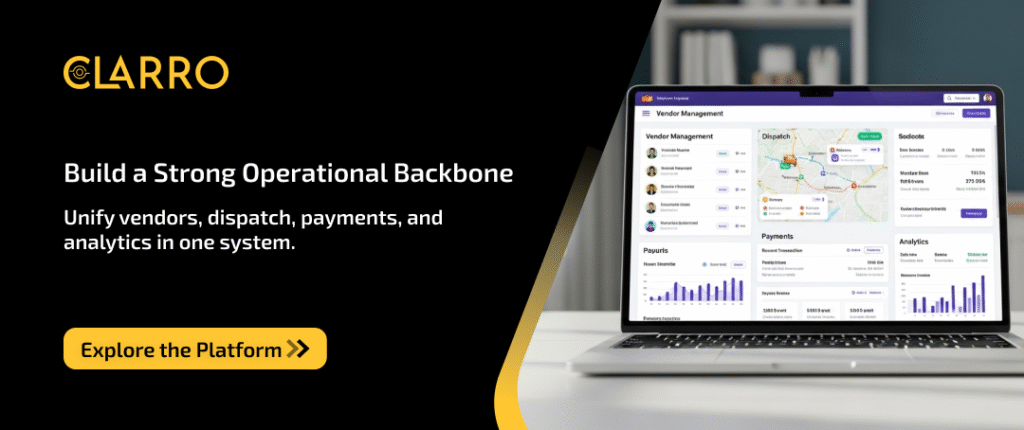
Behind every successful platform is a system that manages vendors, automates workflows, balances supply and demand, and ensures seamless execution at scale. From onboarding and dispatching to payments and analytics, these systems form the operational backbone that keeps everything running efficiently.
In this guide, we’ll break down how large service marketplaces actually operate behind the scenes, the key systems that power them, the challenges businesses face while scaling, and how the right software can help build a scalable, future-ready marketplace.
Why Most Marketplaces Fail to Scale (And It’s Not the App)
Most service marketplaces don’t fail at launch; they fail during growth.
In the early stages, everything looks promising. A marketplace launches with a simple model: onboard vendors, attract customers, and start fulfilling requests. With limited volume, even manual coordination works. Founders often rely on spreadsheets, basic tools, or small teams to manage operations, and the system holds up.
But scaling changes everything.
As order volume increases, operational complexity grows exponentially. More vendors mean inconsistent availability, varying service quality, and higher coordination effort. More customers mean tighter expectations around speed, reliability, and pricing. What once felt manageable quickly turns into operational friction.
This is where most marketplaces hit a breaking point.
According to insights from McKinsey & Company, many digital platforms encounter a “wall to scale” driven by operational complexity, fragmented workflows, and execution gaps, not product limitations. Similarly, data from Statista highlights that customer churn in service marketplaces often increases when fulfillment delays and service inconsistencies rise, both of which are operational issues.
The reality is simple: A marketplace doesn’t scale because of its interface; it scales because of its systems.
Without structured operations, marketplaces face recurring challenges:
- Supply-demand imbalance (too many orders, not enough reliable vendors)
- Vendor inconsistency and lack of accountability
- Delayed service fulfillment and poor scheduling
- Increasing reliance on manual coordination
- Fragmented workflows across teams
At this stage, growth becomes counterproductive. Adding more users or vendors doesn’t improve performance—it amplifies inefficiencies.
This is where the concept of an operational backbone becomes critical.
Behind every large-scale marketplace is a set of interconnected systems that manage vendors, automate workflows, optimize matching, and ensure seamless execution. This backbone, typically powered by multi vendor marketplace software, is what transforms a growing platform into a scalable one.
Instead of reacting to problems manually, businesses with strong operational systems can:
- Automate vendor onboarding and performance tracking
- Balance supply and demand in real time
- Ensure consistent service delivery
- Scale operations without increasing complexity
In short, the difference between a marketplace that struggles and one that scales isn’t the idea; it’s the infrastructure behind it.
Understanding this foundation is the first step toward building a marketplace that can grow without breaking.
What is Multi Vendor Marketplace Software?

At its core, a marketplace is a simple concept: connect buyers with sellers and facilitate transactions. But as soon as you move beyond a small number of users, that simplicity disappears.
This is where multi vendor marketplace software comes in.
A multi vendor marketplace platform acts as the central system that connects three key components:
- Customers who request or purchase services
- Vendors or service providers who fulfill those requests
- The platform that manages interactions, transactions, and operations
In the early stages, these interactions can be managed manually or with basic tools. However, as the platform grows, managing hundreds, or even thousands, of vendors and transactions becomes increasingly complex.
For example, in service marketplaces like home services, logistics, or on-demand platforms, the system must handle:
- Vendor onboarding and verification
- Real-time availability and scheduling
- Service assignment and dispatching
- Pricing, commissions, and payments
- Customer communication and support
Without a structured system in place, these processes quickly become fragmented and inefficient.
This is why businesses rely on marketplace platform software—not just to connect users, but to orchestrate and automate every operational layer behind the scenes.
Instead of managing operations manually, a well-designed marketplace system ensures that:
- Vendors are onboarded and monitored consistently
- Customer requests are matched with the right service providers in real time
- Pricing and transactions are handled transparently
- Operations scale without increasing complexity
This is also where many growing platforms start exploring marketplace management systems to centralize control, automate workflows, and maintain operational efficiency as they scale. By adopting a solution like Clarro’s marketplace-ready SaaS platform, you can manage bookings, payments, and multi-role users from a single dashboard.
In essence, multi vendor marketplace software is not just a tool; it’s the infrastructure that enables a marketplace to function efficiently, adapt to growth, and deliver a consistent user experience at scale.
As marketplaces expand, this software evolves from a support system into the core engine that powers every interaction, decision, and transaction on the platform.
The Operational Backbone of Scalable Marketplace Platforms
As a marketplace grows, operations become exponentially more complex. What starts as a simple flow of connecting customers with vendors quickly evolves into a multi-layered system that must handle real-time decisions, coordination, and execution at scale.
This is where the operational backbone becomes essential.
A scalable marketplace is not powered by a single feature—it relies on a set of interconnected systems that work together to manage vendors, automate workflows, and ensure consistent service delivery. Without this backbone, growth leads to inefficiency instead of expansion.
Let’s break down the core components that power scalable marketplace platforms:
- Vendor Management System
Vendors are the supply side of your marketplace, and their reliability directly impacts customer experience. A robust vendor management system ensures:
- Structured onboarding and verification processes
- Real-time availability tracking
- Performance monitoring (ratings, completion rates, cancellations)
- Incentive and penalty management
At scale, manual vendor handling leads to inconsistency and poor service quality. A centralized system ensures standardization, accountability, and long-term vendor retention.
- Marketplace Management System
This acts as the command center of the entire platform. A marketplace management system enables businesses to:
- Control users, vendors, and services from a unified dashboard
- Configure workflows and business rules
- Manage service categories, pricing logic, and operations
- Monitor platform activity in real time
Without this layer, operations become fragmented across tools and teams, making it difficult to scale efficiently.
- Smart Matching & Dispatch Engine
One of the most critical components in any service marketplace is how requests are assigned.
A smart dispatch engine:
- Matches customer requests with the most relevant vendor
- Considers location, availability, skills, and response time
- Optimizes allocation to reduce delays and improve efficiency
As order volume increases, manual assignment becomes impossible. Automated dispatch systems ensure faster response times and better resource utilization.
This is where many platforms adopt automated dispatch and matching systems to improve operational efficiency and customer satisfaction.
- Pricing, Commission & Revenue Logic
Revenue in a marketplace depends on how well pricing and commissions are managed. This system handles:
- Dynamic pricing based on demand and supply
- Commission structures for vendors
- Discounts, surge pricing, and promotional offers
Without automated pricing logic, marketplaces risk inconsistencies, revenue leakage, and reduced profitability.
- Order & Scheduling System
Efficient execution depends on how well orders are managed from booking to completion.
This system ensures:
- Seamless booking and time-slot allocation
- Real-time tracking of service progress
- Coordination between customers and vendors
- Timely fulfillment of requests
As marketplaces scale, scheduling conflicts and delays become common without automation.
To handle this, businesses rely on automated order and scheduling systems that streamline bookings and improve service delivery timelines.
- Payments & Settlement System
Handling financial transactions at scale is one of the most complex challenges in a marketplace.
A reliable payment system manages:
- Secure customer transactions
- Split payments between the platform and vendors
- Automated vendor payouts
- Commission deductions and reconciliation
Manual financial handling leads to errors, delays, and a lack of transparency.
This is why platforms implement secure payment and settlement systems to ensure accurate transactions and build trust across the ecosystem.
- Analytics & Performance Monitoring
Scaling without visibility leads to inefficiency. Analytics systems provide:
- Real-time dashboards for operational insights
- Vendor performance tracking
- Demand forecasting and trend analysis
- Identification of bottlenecks and inefficiencies
These insights allow businesses to continuously optimize operations and make data-driven decisions.
Many marketplaces adopt advanced analytics and reporting tools to gain visibility and improve overall platform performance.
Bringing It All Together
Each of these systems plays a specific role, but their real power lies in integration.
A scalable marketplace doesn’t operate on disconnected tools; it relies on a unified infrastructure where vendor management, dispatching, payments, and analytics work together seamlessly.
This is why businesses invest in multi vendor marketplace software, to bring all these operational layers into a single system that can handle growth without increasing complexity.
When built correctly, this operational backbone allows marketplaces to scale efficiently, maintain service quality, and deliver a consistent experience, even as demand grows rapidly.
Key Challenges in Scaling a Marketplace Business
Scaling a marketplace isn’t just about increasing users—it’s about managing complexity without breaking operations.
Many platforms experience rapid early growth, but as they scale, underlying inefficiencies start to surface. Without the right systems in place, growth amplifies problems instead of solving them.
Below are the most common challenges businesses face when trying to scale a marketplace:
Supply-Demand Imbalance
One of the biggest challenges in any marketplace is maintaining the right balance between customers and vendors.
- Too many customers → delayed services and poor experience
- Too many vendors → low utilization and dissatisfaction
At scale, even small imbalances can lead to lost revenue and reduced trust. Managing this requires real-time visibility and dynamic allocation systems—not manual guesswork.
Read more: Common challenges in multi-vendor marketplace management (and how the right software helps)
Vendor Churn and Inconsistent Quality
Vendors are the backbone of service delivery, but retaining them becomes difficult as competition and expectations grow.
Common issues include:
- Inconsistent service quality
- High cancellation rates
- Lack of accountability
- Vendors switching platforms for better incentives
Without structured performance tracking and engagement systems, marketplaces struggle to maintain a reliable supply base.
Operational Dependency on Manual Processes
In the early stages, manual coordination works. Teams manage orders through calls, spreadsheets, or basic tools.
But at scale:
- Manual scheduling leads to delays
- Human errors increase
- Coordination becomes inefficient
- Teams spend more time managing operations than growing the business
This creates a bottleneck where operations cannot keep up with demand
Lack of Automation and Real-Time Decision Making
Modern marketplaces operate in real time. Customers expect instant confirmations, accurate ETAs, and seamless service.
Without automation:
- Matching requests to vendors becomes slow
- Pricing remains static and inefficient
- Decision-making is delayed
- Customer experience suffers
Automation is no longer optional—it’s essential for handling scale.
Fragmented Systems and Poor Visibility
Many growing marketplaces rely on multiple disconnected tools for different operations—vendor management, payments, scheduling, and analytics.
This leads to:
- Data silos
- Lack of real-time insights
- Inefficient workflows
- Difficulty in making strategic decisions
Without a unified system, scaling becomes chaotic rather than controlled.
Why These Challenges Matter
These challenges don’t appear overnight; they build gradually as the platform grows. And if not addressed early, they can limit growth, reduce profitability, and impact customer trust.
This is exactly why businesses looking at how to scale a marketplace business shift their focus from growth tactics to operational efficiency.
Many platforms address these challenges by adopting multi vendor marketplace software solutions that automate workflows, centralize operations, and provide real-time control over the entire ecosystem.
In the next section, we’ll break down how to build a marketplace with scalability in mind—so these challenges can be addressed before they become critical.
How to Build a Multi Vendor Marketplace (Step-by-Step Thinking)
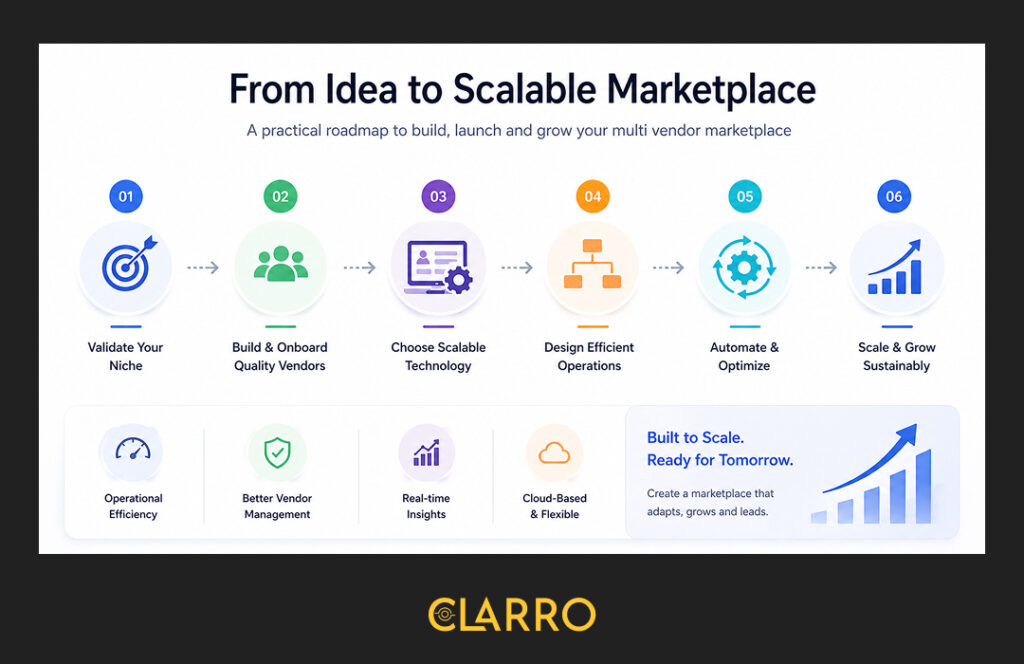
Building a successful marketplace isn’t just about launching a platform—it’s about designing systems that can scale from day one. Many founders focus on features and UI early on, but long-term success depends on how well the operational foundation is planned.
If you’re exploring how to build a multi vendor marketplace, here’s a practical, operations-first approach used by scalable platforms:
- Define a Clear Niche and Value Proposition
Start by narrowing your focus.
Instead of targeting a broad audience, successful marketplaces begin with a specific niche—home services in a city, niche logistics, B2B services, or specialized providers. A focused niche helps:
- Build strong initial demand
- Attract relevant vendors
- Deliver consistent service quality
Clarity at this stage reduces complexity later and makes it easier to scale in a controlled way.
- Build Supply Before Demand
One of the most common mistakes is prioritizing customers before ensuring a reliable supply.
Without enough quality vendors:
- Customer requests go unfulfilled
- Service delays increase
- Early user experience suffers
Successful marketplaces invest early in:
- Vendor onboarding and verification
- Training and quality standards
- Ensuring availability across key locations
A strong supply base creates the foundation for sustainable growth.
- Choose the Right Technology Foundation
Technology decisions made early can define your ability to scale later.
Instead of relying on basic tools or disconnected systems, it’s important to invest in a platform that can handle:
- Vendor management
- Real-time dispatch and scheduling
- Pricing and commission logic
- Payments and analytics
This is where businesses explore marketplace platform software that supports end-to-end operations and reduces the need for multiple tools.
Choosing scalable technology early prevents costly rebuilds and operational bottlenecks as your marketplace grows.
Read more: How service management software helps small businesses centralize operations and scale efficiently
- Design for Operations, Not Just Features
Many marketplaces fail because they focus on front-end experience but ignore backend workflows.
To scale effectively, you need to design:
- Clear service workflows
- Automated order handling
- Defined vendor responsibilities
- Efficient communication between users and providers
An operations-first mindset ensures that your marketplace can handle growth without relying on manual coordination.
- Automate Early to Avoid Scaling Bottlenecks
Automation is what transforms a marketplace from a manual operation into a scalable business.
Key areas to automate include:
- Vendor onboarding and verification
- Order assignment and dispatching
- Scheduling and fulfillment tracking
- Payments and settlements
Platforms that implement automation-driven marketplace systems early can scale faster while maintaining consistency and efficiency.
- Plan for Scalability from Day One
Even if your marketplace starts small, your systems should be designed for growth.
This includes:
- Handling increasing transaction volume
- Supporting more vendors across regions
- Maintaining performance during peak demand
- Ensuring a consistent user experience
Scalability is not something you add later; it’s something you build into your foundation.
Building a marketplace is not just about connecting buyers and sellers; it’s about creating a system that can operate efficiently at scale.
By focusing on niche clarity, strong supply, the right technology, and early automation, businesses can avoid the common pitfalls that limit growth.
In practice, the most successful marketplaces don’t just launch fast; they build with scalability in mind from the very beginning, supported by the right systems and infrastructure.
Why SaaS Marketplace Software is Essential for Scaling
As marketplaces grow, relying on manual processes and disconnected tools quickly becomes a limitation. Tasks like vendor coordination, scheduling, and payments become harder to manage, leading to delays, errors, and inconsistent service delivery.
This is where SaaS-based marketplace solutions make a significant difference.
Cloud-based marketplace platform software enables businesses to centralize operations, automate workflows, and scale without increasing operational complexity. Instead of managing multiple systems, everything, from vendor management to analytics, runs on a unified platform.
Key advantages include:
- Automation: Reduces manual effort in dispatching, scheduling, and payments
- Flexibility: Easily adapt workflows, pricing, and services as the business grows
- Scalability: Handle increasing users, vendors, and transactions without system breakdowns
This is why many growing platforms adopt multi vendor marketplace software solutions to streamline operations and build a scalable, future-ready marketplace.
In a competitive landscape, the ability to scale efficiently isn’t just an advantage—it’s a necessity.
How Clarro Supports Scalable Marketplace Operations
As marketplaces grow, the difference between smooth scaling and operational chaos often comes down to the systems powering them. This is where Clarro positions itself—not just as a tool, but as an operations-first, cloud-based platform designed specifically for scaling service marketplaces.
Clarro is built to serve as a centralized SaaS solution that brings all critical marketplace operations into a single unified system. Instead of relying on multiple disconnected tools, businesses can manage vendors, orders, workflows, and performance from a single platform.
What sets Clarro apart is its operations-first approach. Rather than focusing only on front-end features, it is designed around how real marketplaces function behind the scenes—handling vendor coordination, real-time dispatching, scheduling, payments, and analytics in an integrated way.
This approach enables businesses to:
- Improve operational efficiency by automating repetitive workflows and reducing manual intervention
- Scale seamlessly as user demand, vendor networks, and transaction volumes increase
- Maintain service consistency through structured processes and real-time monitoring
- Adapt quickly with flexible configurations for pricing, workflows, and service models
As a cloud-based platform, Clarro also provides the flexibility and reliability needed for modern marketplaces, allowing teams to manage operations from anywhere while ensuring performance and uptime at scale.
Businesses looking to streamline operations and reduce complexity often explore multi vendor marketplace software solutions like Clarro to build a scalable, future-ready infrastructure.
In practice, platforms that adopt an integrated SaaS solution early are better positioned to handle growth, optimize performance, and deliver a consistent user experience—without the operational bottlenecks that typically limit scaling.

Final Thoughts: Marketplace Success is Built on Systems, Not Just Apps
Building a marketplace is easy; scaling it is where most platforms struggle.
As demand grows, success depends less on features and more on how well your operations are structured. Without strong systems to manage vendors, workflows, and transactions, growth quickly leads to inefficiency and poor user experience.
The most successful marketplaces focus on building a solid operational foundation from the start, one that supports automation, consistency, and scalability.
In the end, it’s not just the idea or the app that defines success, but the systems behind it that keep everything running smoothly at scale.
Continue Your Journey
To go deeper into building scalable platforms, explore our guide on Key Features of Marketplace Software and discover the essential capabilities that drive efficiency, automation, and long-term growth.
FAQs:
1. What is multi vendor marketplace software?
Multi-vendor marketplace software is a platform that enables multiple vendors to offer products or services to customers through a single system. It manages vendor onboarding, service listings, order processing, payments, and overall marketplace operations in one place.
2. Why do most marketplaces struggle to scale?
Most marketplaces struggle to scale due to operational challenges such as supply-demand imbalance, manual processes, vendor inconsistency, and lack of automation. Without structured systems, growth increases complexity instead of efficiency.
3. What are the key systems required to run a scalable marketplace?
A scalable marketplace relies on core systems like vendor management, order and scheduling, dispatch and matching, payments and settlement, and analytics. These systems work together to automate operations and ensure smooth service delivery.
4. How does marketplace software help in scaling a business?
Marketplace software helps scale a business by automating workflows, centralizing operations, improving vendor coordination, and enabling real-time decision-making. This reduces manual effort and allows the platform to handle higher demand efficiently.