Running a service business is one thing. Scaling it is a challenge of an entirely different order.
When your team is small and the job volume is manageable, informal systems hold up reasonably well. A shared calendar, a few group messages, and a manual invoice here and there can get you through the week. But the moment you start handling dozens of jobs a day, coordinating multiple technicians, tracking customer history, chasing payments, and trying to grow revenue at the same time, that informal foundation gives way.
This is precisely why platform-based service companies are increasingly relying on service business management software to keep their operations running smoothly. Not just to stay organised, but to build a reliable system that supports growth without creating chaos.
Whether you operate in home cleaning, HVAC, landscaping, salon services, or any other field service vertical, the core challenge is the same: you are managing too many moving parts for any one person to coordinate manually. Customers, staff, schedules, payments, and communication all need to work in sync, and when they do not, the business pays the price.
This guide explains exactly how the right software helps platform-based service businesses manage operations at scale and what to look for when evaluating your options.
What Makes a Service Business “Platform-Based”?
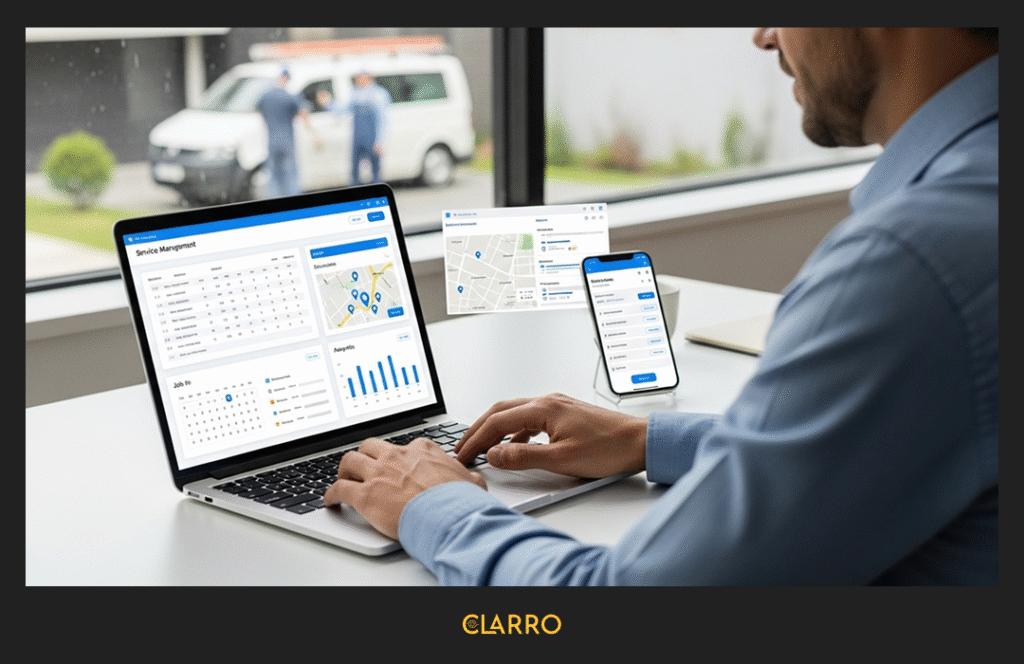
A platform-based service business runs through a centralised digital system, a single platform that connects customers, service providers, scheduling, payments, and communication all in one place.
In a traditional service business, operations are held together by relationships and institutional memory. The owner knows every customer, every technician, and every job by feel. That works until the business grows beyond what one person can carry.
A platform-based model replaces that dependency on individual knowledge with systems. Customers book online. Jobs are assigned automatically. Field teams receive real-time updates. Payments are processed the moment a job is completed. And the business owner has full visibility into everything, from any device, at any time.
This shift from people-dependent to system-dependent is what allows service businesses to grow without the owner becoming the bottleneck. And it is increasingly the standard model for service companies that want to scale.
Platforms purpose-built for this kind of operation, including solutions designed for on-demand home services, are specifically engineered to handle the coordination complexity that grows alongside a scaling service business.
What Breaks Down When You Scale Without the Right Systems
Before exploring what good software does, it helps to understand what actually goes wrong when a service business grows without a proper operational infrastructure in place.
Scheduling becomes unmanageable
At five jobs a day, a shared calendar is workable. At fifty jobs across multiple technicians, the same approach produces double bookings, missed appointments, and wasted travel time. Manual scheduling simply cannot keep pace with demand.
Cash flow becomes unpredictable
As volume increases, tracking invoices, outstanding payments, and actual revenue becomes increasingly difficult without a centralised system. Business owners often lose visibility into their own cash flow, finding out about problems only after they have already caused damage.
Customer communication falls apart
Customers expect timely confirmations, reminders, and follow-ups. Sending these manually at scale is not realistic. When communication slips, customers cancel, complain, or quietly move on to a competitor.
Team accountability becomes harder to maintain
When you have multiple technicians in the field, knowing where everyone is, whether jobs are being completed on time, and how the team is performing requires more than a phone call. Without visibility, you cannot manage what you cannot see.
Reporting is missing or outdated
Growing service businesses need accurate data to make good decisions. Without centralised reporting, owners end up making calls based on gut feel, which works when the business is small, but increasingly costly as it grows.
How Service Business Management Software Addresses Each of These Challenges
Modern service business management software is purpose-built to solve these exact pain points through automation, centralisation, and real-time visibility. Here is how the best platforms tackle what matters most.
Scheduling and dispatching without the manual work
The operational core of any service business is getting the right person to the right job at the right time. A quality SaaS platform handles this with automated scheduling, smart dispatching, and real-time calendar visibility across the entire team.
With purpose-built scheduling and dispatching tools, service businesses eliminate double bookings, reduce travel time through smarter routing, and ensure field teams always have what they need before a job begins. Customers receive automatic confirmations and reminders without anyone on your team lifting a finger.
Online booking that converts visitors into customers
Today’s customers expect to book services on their own schedule, not during your office hours. Service scheduling software for small business owners that includes a self-service booking portal lets customers book at any hour, which reduces inbound calls and turns more website visitors into confirmed jobs.
For platform-based businesses, this capability is foundational. The ability to accept and manage bookings automatically is one of the clearest dividing lines between a scalable operation and one that depends entirely on a human coordinator.
Invoicing and payment collection that keeps cash flowing
Chasing outstanding invoices is a persistent drain in service businesses. At scale, doing it manually is not viable. Good software automates the entire billing cycle — from job completion to invoice to payment, without requiring anyone to manage it by hand.
With online invoicing and payment tools built into the platform, businesses can send invoices the moment a job closes, offer customers multiple ways to pay, and track outstanding balances in real time. The improvement to cash flow visibility alone justifies the investment for most growing businesses.
Customer management that scales with your business
Service businesses run on relationships. But when you are serving hundreds of customers, keeping track of preferences, service history, and communication context is impossible without a dedicated system.
A strong customer management platform centralises every customer interaction in one place — booking history, notes, communication logs, and feedback. Any team member can pick up a customer conversation without losing context, and the business can deliver a consistent, personalised experience regardless of how large it grows.
Business process automation that frees your team
One of the most meaningful advantages of cloud-based service platforms is their capacity for automation. Business process automation for service companies covers everything from appointment reminders and job follow-ups to review requests, recurring billing, and performance reports, all triggered automatically based on defined workflows.
Automation is not about replacing your team. It is about removing low-value, repetitive tasks so your people can focus on the work that actually requires their attention. A well-built SaaS platform includes these workflows out of the box.
Automated marketing that keeps customers coming back
Growing a service business requires more than operational efficiency. You also need to stay visible to past customers, encourage repeat bookings, and build a strong online reputation. At scale, doing this manually is not feasible.Platforms with built-in automated marketing and customer reminders allow businesses to run targeted SMS and email campaigns, automatically request reviews after completed jobs, and re-engage customers who have not booked recently — without adding to anyone’s workload.
Why SaaS Is the Right Foundation for Service Business Platforms
SaaS (Software as a Service) means the software is delivered through the cloud rather than installed locally on your machines. For service businesses, this distinction has real, practical implications.
A SaaS platform requires no expensive hardware, no complex IT infrastructure, and no large upfront investment. You access everything through a browser or a mobile app on a predictable monthly subscription. Updates roll out automatically. New features appear without any action on your part. Your data is stored securely and backed up.
More importantly, SaaS platforms scale with your business. Whether you have five technicians in the field or fifty, the software adapts to match. You are not paying for capacity you do not need, and you are not hitting a ceiling when demand grows.
For service businesses in Canada, particularly, working with experienced SaaS development teams, whether to build a custom platform or to properly implement an existing one, is becoming a meaningful competitive advantage.
When an off-the-shelf solution does not fully fit a business’s operational model, working with custom SaaS application development specialists allows service businesses to build exactly the platform they need, purpose-fit to their workflows, team structure, and customer base.
What to Look for When Choosing the Right Platform
When evaluating field service management software or a broader service business platform, the feature list matters, but it is not where you should start. Begin by identifying your specific operational gaps. Then look for a platform that closes them.
That said, the following capabilities are foundational for any platform-based service business that wants to scale:
- Scheduling and dispatching: Automated job assignments, real-time calendar management, and smart routing
- Online booking portal: Customer-facing self-service booking that works 24/7 without manual input
- Invoicing and payments: Automated billing, multiple payment options, and live cash flow tracking
- CRM and customer history: Centralised records of every booking, communication, and service interaction
- GPS and field visibility: Real-time tracking of field teams and job progress
- Marketing automation: SMS and email workflows, review generation, and customer retention campaigns
- Reporting and analytics: Live dashboards and custom reports that surface actionable business data
- Third-party integrations: Connections to accounting tools like QuickBooks and open APIs for custom workflows
- Mobile accessibility: A fully functional mobile experience so field teams can manage their day from anywhere
The strongest platforms combine all of these into a single, unified system. This is the promise of cloud-based business operations software: replacing a fragmented stack of disconnected tools with one coherent platform that everyone in the business, in the office and in the field, actually uses.
When evaluating options, prioritise platforms that offer a free trial, transparent pricing, and onboarding support. The best software in the world has no value if your team does not adopt it.
Conclusion
Scaling a service business is achievable, but it requires the right foundation. Without systems in place, growth amplifies the problems that already exist rather than solving them. With the right service business management software, those problems are addressed before they have a chance to take root.
The platform-based service businesses that grow sustainably are not necessarily the ones with the most staff or the lowest prices. They are the ones that operate with precision, where every job is tracked, every customer is managed, every payment is collected on time, and every team member knows exactly what is expected of them.
That level of operational clarity does not happen by accident. It is built deliberately, through the right systems. And today, those systems are more accessible and more affordable than they have ever been.
If you are serious about scaling your service business without losing control of your operations, the logical next step is finding the right platform and getting your team on it.
Continue Your Journey
Service Business Management Software: Run Operations From One Platform
A practical deep-dive into how all-in-one service platforms centralise operations, eliminate silos, and give growing businesses full control from a single system.
Frequently Asked Questions:
1. What is service business management software?
It is a digital platform that brings together the core operations of a service business — scheduling, dispatching, invoicing, customer management, and reporting — into one system. It replaces disconnected tools and manual processes with a single, centralised workflow that the entire team can work from.
2. How does a SaaS platform help a service business scale?
SaaS platforms are cloud-based, require no local installation, and update automatically. They scale alongside your business, whether you have five technicians or fifty, without requiring infrastructure changes. Automation and real-time data visibility are the two capabilities that make the biggest difference when volume increases.
3. What is the difference between field service management software and general business management software?
Field service management software is purpose-built for businesses that send teams to customer locations — HVAC, cleaning, plumbing, landscaping, and similar industries. It includes capabilities like GPS tracking, mobile dispatch, and on-site job management that general business software typically does not address.
4. Can small service businesses benefit from this type of software?
Yes — many platforms are specifically designed for small and growing service businesses, with affordable plans and straightforward onboarding. Starting with the right software early makes the eventual transition to higher volume significantly smoother and less disruptive.
5. How do I choose the right platform for my service business?
Start with your biggest operational pain points, not the feature list. Identify where jobs are getting missed, where cash flow is unclear, or where customer communication is falling short. Then look for a platform that directly addresses those gaps, offers a free trial, and provides solid onboarding support. Test before committing, and involve your team in the evaluation