
Running a trades or home service business in Canada comes with a layer of operational and legal complexity that most popular software platforms were never designed to handle. The tax structure varies by province. Privacy law obligations differ from those in the United States. Anti-spam rules govern every automated message your scheduling platform sends to a customer. And yet, the majority of cloud-based field service management software options dominating search results were built for the American market first, with Canada added later as an afterthought.
For an HVAC contractor in Ontario, a plumbing company in Alberta, or a cleaning service operating across British Columbia, this gap is not just inconvenient. It is a compliance risk that can manifest as incorrect invoices during a CRA audit, a data breach under PIPEDA, or a CASL violation arising from an automated review request.
This guide covers what field service management software Canada-based service businesses genuinely need, from the tax-handling and privacy requirements no one talks about to the core features that drive real operational efficiency in the field.
What Is Field Service Management Software?
Field service management (FSM) software is a cloud-based, all-in-one platform that connects your back office with your field teams. It handles every step of a job, from the moment a customer books to the moment payment clears, inside a single SaaS system that eliminates spreadsheets, paper job sheets, and disconnected tools.
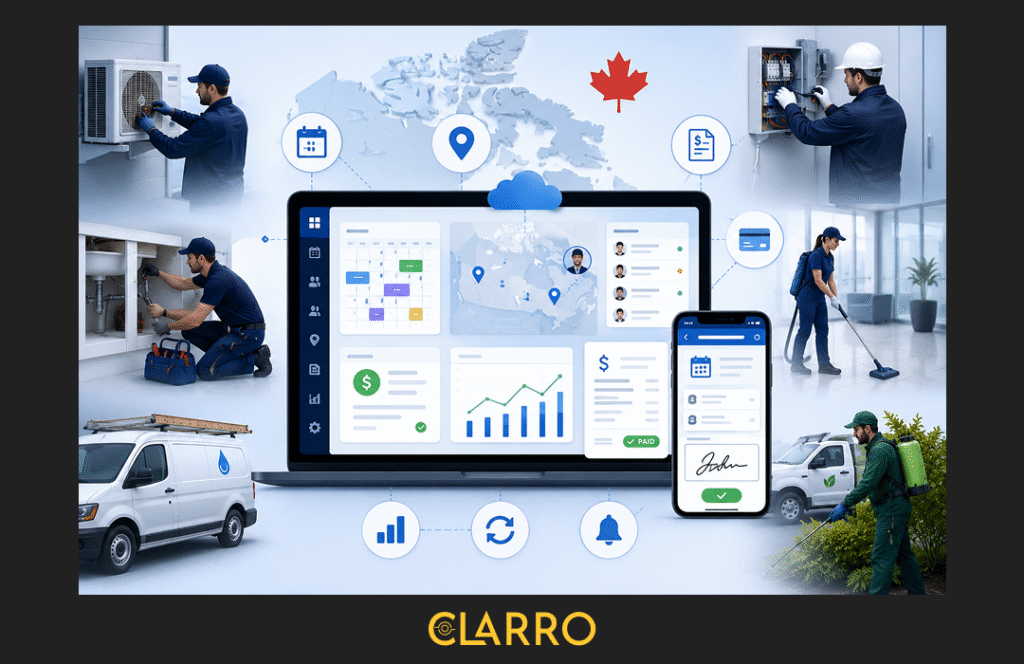
For Canadian HVAC companies, plumbing contractors, cleaning services, electricians, landscapers, and pest control operators, FSM software manages:
- Job scheduling and technician dispatching with real-time GPS tracking
- Customer estimates and pricebook-based quoting
- Invoicing with the correct provincial tax applied automatically
- Mobile tools for technicians to access job details, collect signatures, and take payment in the field
- Recurring service plans with automated renewal reminders
- Reporting and analytics on job profitability, technician performance, and revenue trends
The reason the “built for Canada” distinction matters comes down entirely to what happens when the software gets any of these wrong under Canadian law.
The Province-by-Province Tax Problem Every Canadian Service Business Faces
The single most common compliance failure when a Canadian service business runs US-designed software is tax handling. Most American platforms support a flat sales tax model. Canada does not work that way, and the differences are not minor.
Depending on the province where your customer’s service is delivered, not where your business is registered, your invoice must apply a different rate and sometimes an entirely different tax authority:
| Province / Territory | Tax Type | Combined Rate |
| Ontario | HST | 13% |
| British Columbia | GST + PST | 12% (5% + 7%) |
| Alberta | GST only | 5% |
| Quebec | GST + QST | ~15% (5% + 9.975%) |
| Nova Scotia | HST | 15% |
| New Brunswick | HST | 15% |
| PEI | HST | 15% |
| Newfoundland & Labrador | HST | 15% |
| Manitoba | GST + RST | 12% (5% + 7%) |
| Saskatchewan | GST + PST | 11% (5% + 6%) |
| Territories (YK, NWT, NU) | GST only | 5% |
Most Canadian service businesses must register for GST/HST once taxable revenue exceeds $30,000 in any 12 months. From that point, every invoice must include your registration number, the correct tax rate for the service location, and a clear breakdown of the tax charged, all as required by the CRA.
Software that applies a flat 5% GST to every invoice, regardless of province, will produce non-compliant invoices in Ontario, Nova Scotia, New Brunswick, and every other HST province. That creates problems during audits and complicates Input Tax Credit claims. Quebec adds further complexity because QST is administered by Revenu Québec, not the CRA, and the remittance process is entirely separate.
Purpose-built FSM software for Canada auto-detects the correct rate based on service location, validates your registration number, and generates invoices that meet CRA requirements without manual adjustment. For HVAC and plumbing businesses managing dozens of jobs across different cities and provinces, this automation is not optional; it is the difference between clean books and a reconciliation nightmare. You can explore how HVAC software built for Canadian operations handles tax compliance alongside scheduling and dispatch in a single workflow.
PIPEDA and Data Residency: Where Your Customer Data Actually Lives
Canada’s Personal Information Protection and Electronic Documents Act (PIPEDA) governs how businesses collect, use, and store personal information about customers in the course of commercial activity. Alberta (PIPA), British Columbia (PIPA BC), and Quebec (Law 25) add provincial requirements on top of the federal baseline, with Quebec’s Law 25 being among the most stringent in North America following its phased implementation through 2023.
The question most service business owners never think to ask when selecting software: Where is your customer data actually stored?
For US-based FSM platforms, the honest answer is almost always on servers in the United States, subject to US federal law, including provisions that allow government agencies to compel access to data held on American servers. This is a structural issue with cloud-based software that stores data outside Canadian jurisdiction, and it is one that PIPEDA squarely addresses. Under PIPEDA, your business carries legal responsibility for personal information even after you transfer it to a third party for processing. If your software vendor suffers a data breach, your customers’ names, addresses, service histories, and payment records are exposed, and your business is accountable.
Canadian service businesses handling sensitive customer data should look for FSM platforms that offer:
- Data storage on Canadian servers (Canadian data residency)
- Encryption in transit and at rest
- Breach notification policies aligned with PIPEDA’s mandatory reporting requirement
- A data processing agreement with the vendor that clearly defines their obligations
For businesses that require a fully custom solution with data sovereignty built into the architecture from the ground up, custom software development services designed around Canadian regulatory requirements offer an alternative to off-the-shelf platforms that retrofit compliance after the fact.
CASL Compliance: The Compliance Risk Hidden Inside Your Scheduling Software
Most Canadian business owners are aware that CASL exists. Very few understand that it directly regulates what their scheduling platform does on their behalf every day.
Canada’s Anti-Spam Legislation prohibits sending commercial electronic messages, including texts, emails, and push notifications, without express or implied consent from the recipient. This applies to appointment reminders, service follow-ups, review requests, renewal notices, and promotional campaigns. Violations carry fines of up to $10 million per day for organizations.
Here is the critical issue: every automated message your FSM software sends on your behalf is a commercial electronic message under CASL. If your platform sends an appointment reminder or a follow-up text to a customer who has not provided valid consent, that is a potential violation, even if the message is not promotional in nature.
FSM platforms built with Canadian compliance in mind should include:
- Consent capture at the point of booking with CASL-compliant opt-in language
- Tracking of consent type (express vs implied) and the date consent was recorded
- Automated suppression of messages to customers who have withdrawn consent
- Functioning unsubscribe mechanisms within 10 business days
When comparing home service software Canada options, ask vendors specifically whether their communication workflows were designed around CASL, not just whether they have an unsubscribe link on emails.

The Real Hidden Cost of Running US-Built Software as a Canadian Business
Here is the conversation nobody has clearly, with actual numbers.
Currency exposure on monthly fees. Most US FSM platforms charge in USD. At current exchange rates, a plan priced at $150 USD per month costs a Canadian business approximately $200–$210 CAD. Over 12 months, that is $400–$600 CAD more than the advertised price, before the rate moves again.
Tax errors are compounding on CRA filings. Software that consistently applies the wrong tax rate generates a year of non-compliant invoices. The CRA does not allow businesses to pass that error on to customers after the fact. You may owe the correct tax regardless of what you collected, plus potential interest and penalties. Accounting firms charge by the hour to reconcile this.
Payment processing gaps. US software typically integrates with US payment processors. Canadian businesses need platforms that support Interac transactions, Canadian bank accounts, and CAD-denominated processing without cross-border surcharges that quietly add 1–3% to every payment collected.
Provincial employment standards were ignored. Field service businesses with employees need software that accounts for the fact that Ontario, BC, Alberta, and Quebec each have different overtime thresholds, statutory holiday entitlements, and vacation pay requirements. Generic US platforms do not differentiate between these.
Support timezone delays. When your dispatch software and scheduling software go offline on a Monday morning in Toronto, waiting for a California support team to come online at noon Eastern is an operational problem with real revenue consequences.
Key Features to Evaluate in Field Service Management Software for Canadian Trades
Beyond compliance, the operational features that drive efficiency for Canadian service businesses are consistent regardless of trade. Here is what to evaluate:
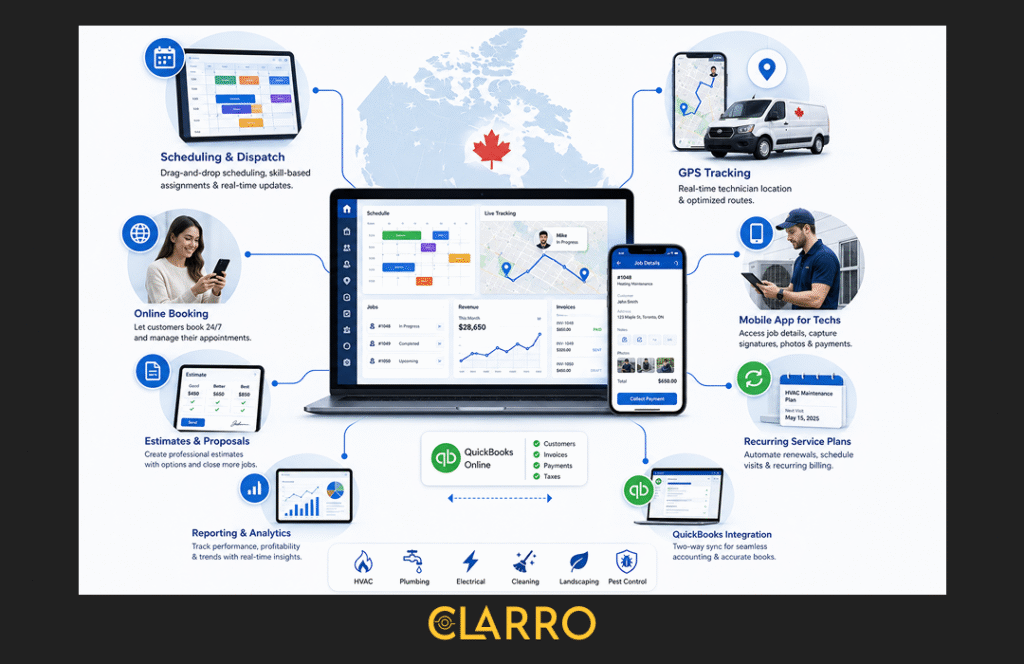
Scheduling and Intelligent Dispatch
Effective scheduling is the core of any field service operation. Look for drag-and-drop calendars, skill-based job assignments, real-time GPS tracking, and automatic conflict detection. The best platforms reduce drive time between jobs, eliminate double bookings, and give your office team and technicians a shared view of the day without phone calls back and forth. Canadian plumbing businesses managing emergency calls alongside booked maintenance jobs need dispatch tools that adapt in real time, which is exactly what plumbing services software built for the trades is designed to do.
Online Booking and Customer Self-Service
Customers increasingly expect to book without calling. Online booking tools that integrate directly with your scheduling calendar capture after-hours leads, reduce inbound calls, and improve the customer experience from the first interaction. A customer portal that lets clients view their service history, approve estimates, and make payments online reduces your admin overhead and gives customers the transparency they expect from a professional service company.
Mobile App for Field Technicians
Your technicians are not at a desk. They need a mobile app that works offline, delivers full job details before they arrive, including equipment history, access notes, and customer preferences, and lets them capture signatures, photos, and payment in the field. Platforms built for Canadian field teams should support the on-demand service model where technicians move between multiple jobs, often without reliable connectivity. The growth of on-demand mobile app platforms for home services reflects how central mobile-first tools have become for modern field operations across Canada.
Estimates, Pricebook, and Proposals
On-site quoting with good-better-best options improves close rates and reduces back-and-forth on approvals. A built-in pricebook with your standard labour rates and materials pricing ensures consistency across technicians and prevents underquoting on jobs. Estimates that flow directly into work orders and invoices eliminate duplicate data entry and speed up the job-to-payment cycle.
Reporting and Business Analytics
You cannot improve what you cannot measure. Advanced reporting tools give operations managers and business owners visibility into technician performance, job profitability, revenue trends, and service agreement renewal rates, without exporting data into spreadsheets. Real-time dashboards make it possible to spot problems early: a technician with a high callback rate, a service category with shrinking margins, or a geographic area where response times are falling behind.
Recurring Service Plans and Maintenance Contracts
For HVAC, plumbing, pest control, and cleaning businesses, maintenance agreements are the most stable revenue source in the business. FSM software should automate renewal reminders, schedule planned maintenance visits, and bill recurring customers automatically, without someone manually tracking contract dates. Businesses that build recurring revenue through service agreements are more resilient during slow seasons and more attractive to buyers if the owner ever decides to sell.
QuickBooks Integration and Accounting Sync
The majority of Canadian service businesses use QuickBooks Online for their accounting. Native two-way sync that automatically pushes customers, invoices, payments, and tax collected into QuickBooks eliminates double-entry bookkeeping, keeps your books accurate in real time, and makes year-end filing significantly less painful.
When Off-the-Shelf Software Is Not Enough
Some Canadian service businesses reach a point where existing SaaS FSM platforms cannot accommodate their specific workflows, compliance requirements, or integration needs. A landscaping company managing municipal contracts with specific reporting requirements, or an HVAC business with proprietary equipment tracking systems, may find that no ready-made platform fits cleanly.
In these cases, custom mobile app development built specifically around your operational model, with Canadian data residency, GST/HST logic, CASL-compliant communication workflows, and custom reporting, becomes a legitimate alternative to adapting your business processes around a generic platform. The upfront investment is higher, but the long-term fit with your operations, compliance posture, and brand is significantly stronger.
How Clarro Helps Canadian Service Businesses Work Smarter
Clarro’s all‑in‑one business management platform is built for Canadian trades and home service businesses, from small plumbing teams to multi-location HVAC operations. Instead of forcing businesses to adjust to generic software, Clarro adapts to real operational workflows.
Its smart scheduling and dispatch system automatically assigns the right technician based on skill, availability, and location, while giving office teams and field staff real-time updates. Built-in GST/HST invoicing applies the correct provincial tax rates automatically, helping businesses stay CRA-compliant with less manual work.
Clarro also includes HVAC and plumbing-specific tools like equipment tracking, maintenance contract automation, service history management, advanced reporting, customer self-service portals, and a technician mobile app with offline access for field teams.
For businesses needing more than standard SaaS tools, Clarro also provides custom software and mobile app development with Canadian data residency, GST/HST logic, and CASL-compliant communication built into the system.
The result is less admin work, smoother operations, better compliance, and more time focused on revenue-generating jobs.
The Bottom Line
The field service management software market in Canada is full of platforms that technically function; they will schedule jobs, generate invoices, and track technicians without breaking. The difference between a platform that works and one that is actually built for Canada is what happens at the edges: when the CRA asks about your tax remittances, when a customer requests their data under PIPEDA, when a CASL audit surfaces your automated messages, or when a US exchange rate shift quietly inflates your operating costs by hundreds of dollars a month.
Canadian service businesses deserve cloud-based software that makes compliance automatic, eliminates the manual workarounds that waste office hours, and gives technicians tools that work in the field regardless of connectivity. Whether you choose an established SaaS FSM platform built with Canadian requirements in mind or invest in a custom-built solution that fits your specific operational model, the right software pays for itself in accuracy, time saved, and compliance risk avoided.
Related Resources for Canadian Service Businesses
Looking to improve scheduling, compliance, dispatch, and customer management across your operations? Explore these additional guides:
HVAC Field Service Management Software Guide
A complete breakdown of scheduling, maintenance plans, dispatch workflows, and compliance tools for Canadian HVAC companies.
Plumbing Services Software for Canadian Contractors
See how plumbing businesses reduce admin work, manage emergency calls, and automate recurring service operations.
Canadian SaaS Tech Stack for Small Businesses
Discover the best cloud-based tools Canadian service companies use for invoicing, operations, communication, and business growth.
Frequently Asked Questions:
1. What is field service management software, and which Canadian trades need it?
Field service management software is a digital platform that manages the full job lifecycle for businesses that deliver services at a customer’s location — from scheduling and dispatch to invoicing and payment. In Canada, it is widely used by HVAC contractors, plumbing companies, electricians, cleaning services, landscapers, pest control operators, and general handyman services. Any business sending technicians to customer locations benefits from FSM software because it eliminates manual scheduling errors, speeds up invoicing, and creates a professional customer experience from booking to payment.
2. Does field service management software in Canada automatically handle GST/HST by province?
It should — but not all platforms do. Canadian FSM software must apply the correct tax rate based on where the service is delivered, not where the business is registered. That means 13% HST in Ontario, 5% GST in Alberta, approximately 15% HST in Nova Scotia, and a separate GST plus QST calculation for Quebec jobs. Software that applies a flat rate to all invoices will produce non-compliant invoices in multiple provinces, creating CRA reconciliation problems. Always confirm with a vendor that tax logic is province-aware before committing to a platform.
3. What is PIPEDA, and does it apply to small service businesses in Canada?
PIPEDA is Canada’s federal private-sector privacy law governing the collection, use, and storage of personal information in commercial activity. It applies to every private-sector business, regardless of size, including sole proprietors and small trades companies. Because field service businesses collect customers’ names, addresses, service histories, payment details, and sometimes property access information, they are fully subject to PIPEDA. The software used to store and process that data must meet PIPEDA requirements, including data breach notification obligations.
4. How does CASL affect the automated messages my service software sends?
Canada’s Anti-Spam Legislation (CASL) requires valid consent before sending any commercial electronic message, including appointment reminders, service follow-ups, and review requests sent via email or text. Every automated message your FSM software sends on your behalf falls under CASL. To comply, your platform must capture and record customer consent at the point of booking, track the type and date of consent, suppress messages to customers who withdraw consent, and provide functioning unsubscribe options. Non-compliance can result in significant fines even when the messages are non-promotional in nature.
5. What should I look for when choosing field service management software for my Canadian business?
Evaluate five things beyond standard features: (1) Whether the platform auto-applies the correct GST/HST/PST rate by service province. (2) Whether customer data is stored on Canadian servers. (3) Whether communication workflows capture CASL-compliant consent. (4) Whether pricing is in CAD or USD. (5) Whether Canadian business hours support is available. A vendor who cannot answer these five questions clearly is offering a US product with Canadian branding, not software built for how Canadian service businesses actually operate under Canadian law.