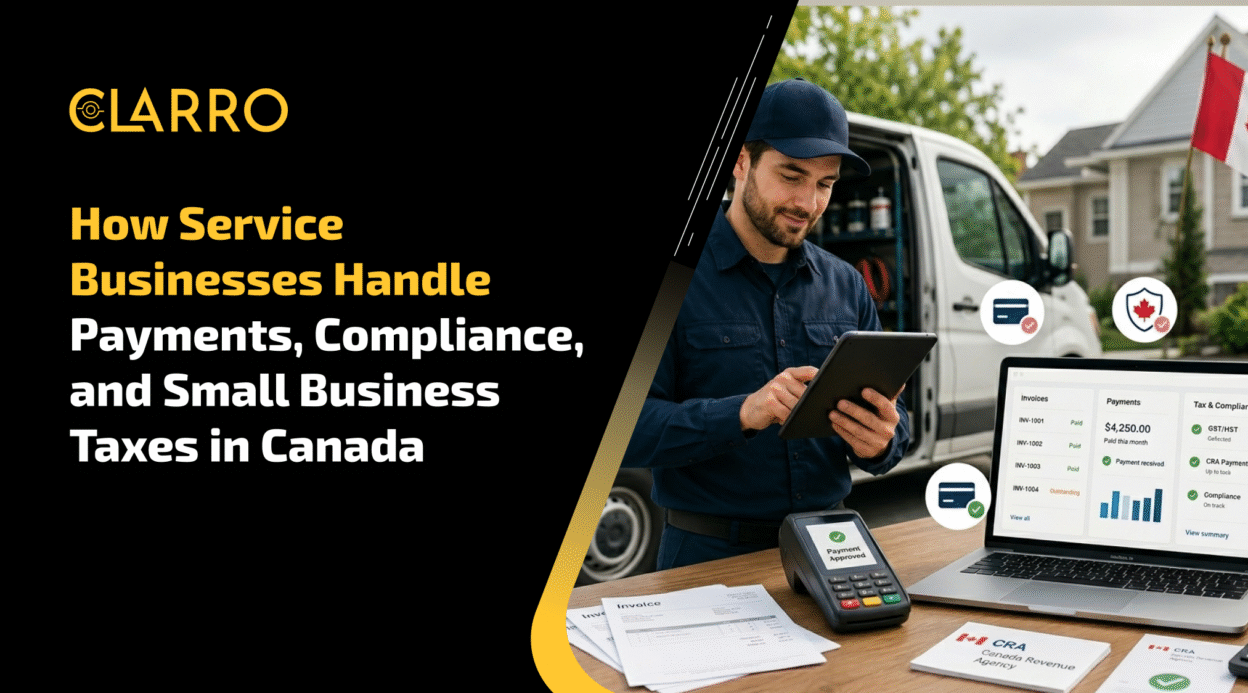
Running a service business in Canada comes with a layer of financial and legal responsibility that most owners figure out the hard way. Whether you operate a cleaning company, HVAC business, landscaping crew, or any trade service, small business taxes in Canada aren’t optional, and getting them wrong is expensive.
The Canada Revenue Agency (CRA) expects you to track income accurately, collect the right sales taxes, invoice properly, and remit on time. Miss any of those steps, and you’re looking at penalties, audits, or worse.
This guide covers everything a Canadian service business owner actually needs to know: how business taxes work for your structure, GST/HST rules, what belongs on a legal invoice, how to accept payments in the field without creating a compliance problem, and where all-in-one business management software turns the whole process from a headache into a system that runs itself.
How Small Business Taxes Work in Canada for Service Businesses
How you pay tax in Canada depends almost entirely on how your business is structured. Service businesses typically operate as one of two things: a sole proprietorship or a Canadian-controlled private corporation (CCPC).
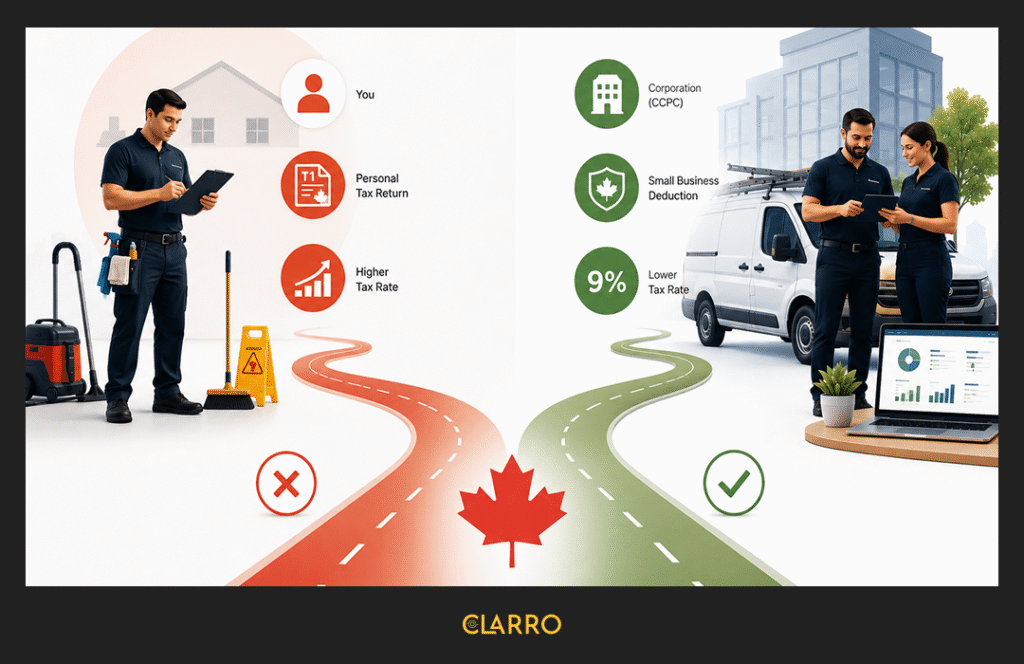
Sole proprietorship means your business income and your personal income are the same thing in the eyes of the CRA. You report everything on your personal T1 return using Form T2125 (Statement of Business or Professional Activities). You pay tax at your personal marginal rate, which can climb as high as 50%+ in some provinces once you’re earning well.
Incorporated businesses are taxed separately. The biggest advantage is access to the Small Business Deduction (SBD), which reduces the federal corporate tax rate to 9% on the first $500,000 of active business income, compared to the standard general corporate rate of 15%. Most provinces stack their own small business rate on top, bringing the combined rate to roughly 11%–13% for most of Canada. That’s a meaningful gap from personal tax rates, and one of the main reasons growing service businesses incorporate.
To qualify for the small business deduction, your corporation must be a Canadian-controlled private corporation (CCPC), earn active business income (not passive investment income), have taxable capital under $10 million, and keep passive income below $50,000 per year to retain full access to the deduction.
If you’re a solo cleaner, solo handyman, or just starting, a sole proprietorship keeps things simple. Once you’re bringing in consistent revenue and growing a team, incorporation usually makes financial sense, especially when you factor in income splitting strategies and the Lifetime Capital Gains Exemption if you ever sell.
For a deeper look at how these structures fit into running a Canadian service operation day-to-day, this guide on how to run a home service business covers the operational side in detail.
The GST/HST Threshold That Every Canadian Service Business Owner Must Know
The most common compliance mistake among service businesses in Canada is waiting too long to register for GST/HST. The rule is straightforward: once your business earns more than $30,000 in revenue across any four consecutive calendar quarters, you are legally required to register for a GST/HST account with the CRA and begin collecting sales tax from your clients.
That $30,000 threshold catches a lot of growing businesses off guard. You hit it faster than you expect, and the moment you do, every invoice you send needs to include the correct tax amount.
Voluntary registration is also worth considering even before you hit the threshold. Registering early lets you claim Input Tax Credits (ITCs), meaning you recover the GST/HST you pay on your own business expenses like tools, fuel, software subscriptions, and equipment. For a trades business spending heavily on materials and supplies, ITCs add up quickly.
Once registered, you choose between two calculation methods:
- Regular Method: You collect GST/HST from clients and subtract the ITCs from your business purchases. The difference is what you remit to the CRA. This approach maximises your credit recovery and works best for most service businesses.
- Quick Method: Designed for smaller operations with annual taxable sales of $400,000 or less, you remit a fixed percentage of your gross sales instead of tracking every ITC. It’s simpler administratively but often results in remitting more than you would under the Regular Method.
Choosing the right method depends on your expense mix. Clarro’s advanced reporting gives you a clear breakdown of your income and expenses across every job, so you can see exactly which method saves you more before you commit.
Province-by-Province Tax Rates: What Service Businesses Need to Know
This is where most generic tax guides fall flat. They explain what GST is but don’t explain what it means when your plumbing company works a job in Ontario one week and Alberta the next, or when your cleaning clients are split between BC and Saskatchewan.
In Canada, the tax rate that applies is based on the place of supply — where the service is delivered or the client is located, not where your business is registered. That means you need to know the rate for wherever your clients are.
| Province / Territory | Tax Type | Rate |
| Alberta | GST only | 5% |
| British Columbia | GST + PST | 5% + 7% = 12% |
| Saskatchewan | GST + PST | 5% + 6% = 11% |
| Manitoba | GST + PST | 5% + 7% = 12% |
| Ontario | HST | 13% |
| Quebec | GST + QST | 5% + 9.975% = ~15% |
| New Brunswick | HST | 15% |
| Nova Scotia | HST | 15% |
| Newfoundland & Labrador | HST | 15% |
| Prince Edward Island | HST | 15% |
| Yukon / NWT / Nunavut | GST only | 5% |
A few things that catch service businesses specifically:
Alberta is the only province with no provincial sales tax. This makes it the simplest market to operate in, 5% GST, full stop. No separate PST return, no provincial portal.
Quebec is the most complex. GST goes to the CRA, but Quebec Sales Tax (QST) at 9.975% is administered separately by Revenu Québec. If you do business in Quebec, you need a separate QST registration and file two returns. All financial documentation, including invoices, must also be in French by default.
BC, Saskatchewan, and Manitoba still use separate PST systems that don’t integrate with the federal GST. You collect and remit them through separate provincial portals, and the rules on what’s taxable can differ from the federal definition.
If you operate across provinces, accounting software that automatically applies the correct rate by client location saves you significant manual effort, and eliminates a common source of CRA errors. Businesses that need this built directly into their own platform often work with a SaaS app development team to embed province-aware tax logic into their core product from day one.
What a CRA-Compliant Invoice Must Include
Every invoice you send is a tax document. The CRA has specific requirements for what a valid invoice must contain, and missing any of them can create problems during an audit or when a client tries to claim ITCs from their own CRA filings.
Here’s what a CRA-compliant invoice requires:
- Your legal business name (or trade name, if registered)
- Your Business Number (BN) and GST/HST registration number (format: 9 digits + RT0001)
- Invoice date and a unique invoice number
- Client’s name or business name
- Clear description of the services provided
- Subtotal before tax
- GST/HST rate applied and the dollar amount charged
- Total amount payable
For invoices over $150, you also need to include the terms of payment and the period covered if it’s for a recurring service.
For invoices under $30, simplified receipts are acceptable and don’t require all fields, but once you’re a registered GST/HST business, the full requirements apply to most transactions.
The CRA requires you to retain all financial records for a minimum of six years from the end of the tax year they relate to. That means invoices, receipts, bank statements, contracts, and payment records, all of them, digital or physical.
Invoicing software built for service businesses handles this automatically, BN auto-fill, correct GST/HST rate by province, sequential invoice numbering, and searchable record storage. It removes the manual checklist entirely.
For tax reporting that’s ready when you need it, advanced reporting tools let you generate CRA-organised summaries of all invoices, payments, and tax collected across any time period, directly from your dashboard.
Accepting Payments in the Field: Cards, E-Transfer, Cash, and CRA Risk
Here’s what most tax guides don’t tell you: how you collect money matters as much as how you invoice it.
Service businesses are different from retail shops. Your technician completes a job at a client’s home, and payment happens right there, not at a front desk, not through an online checkout. That field-payment moment is where a lot of compliance problems start.
The CRA’s Underground Economy Campaign
The CRA runs an active enforcement campaign targeting what it calls the “underground economy”, undeclared income in cash-heavy industries. Home services, trades, and personal care businesses are specifically named as high-risk sectors in this campaign. Auditors look for patterns like significant cash revenue, no payment records, or inconsistencies between declared income and lifestyle indicators.
This doesn’t mean cash is illegal. It means every cash payment must be documented the same way every card payment is. You need a receipt, a matching entry in your books, and a record that the associated GST/HST was collected and remitted. “I forgot to record that one” is not a defence the CRA accepts.
Payment Methods and What They Require
Credit and debit card payments are the cleanest option from a compliance standpoint. Every transaction creates an automatic record through your payment processor, which maps directly to your invoice and accounting system. There’s no cash-handling gap, no missing receipt, no “he said he paid, I said I didn’t get it.”
When clients book through an online booking system and pay on the job site via card or payment link, the payment is recorded the moment it’s made, with a digital trail attached to the job automatically from the very first appointment.
For technicians working across multiple sites, a mobile payment processing solution lets them collect from their phone, no separate terminal needed. Clients can pay by card, e-transfer link, or tap-to-pay on the spot.
A card reader for service businesses is worth the investment specifically because it eliminates the pressure some clients feel to pay cash “to avoid a record.” Tap-to-pay takes seconds, and it protects both you and your client.
E-transfer is widely used in Canada and leaves a clear digital trail, but you need to ensure every e-transfer is recorded against the correct invoice in your accounting system. The gap happens when transfers are received into a personal account, mixed with personal funds, and never properly categorised.
Cash is legal but risky from a compliance standpoint. If you accept cash, issue a numbered receipt immediately, record it against the invoice, and book the GST/HST portion separately. Keep a petty cash log. A pattern of unreported cash income is one of the most common triggers for a CRA audit in the home services sector.
Worker Classification Mistakes That Cost Canadian Service Businesses Thousands
This is the compliance issue most service businesses don’t realise they have until CRA comes knocking, and by then, the liability has often been building for years.
The question is simple on the surface: is the person working for you an employee or an independent contractor (subcontractor)? The answer has enormous tax implications.
If someone is an employee, you are responsible for:
- Deducting and remitting CPP contributions (employer and employee portions)
- Deducting and remitting EI premiums
- Withholding income tax at source
- Providing a T4 slip at year-end
- Compliance with provincial employment standards (vacation pay, termination notice, etc.)
If someone is a subcontractor, they handle their own tax obligations. You pay them, they invoice you, and you have no remittance obligation, though you may need to issue a T4A if payments exceed $500 in a year.
The problem is that many service businesses treat people as subcontractors when the CRA would classify them as employees.
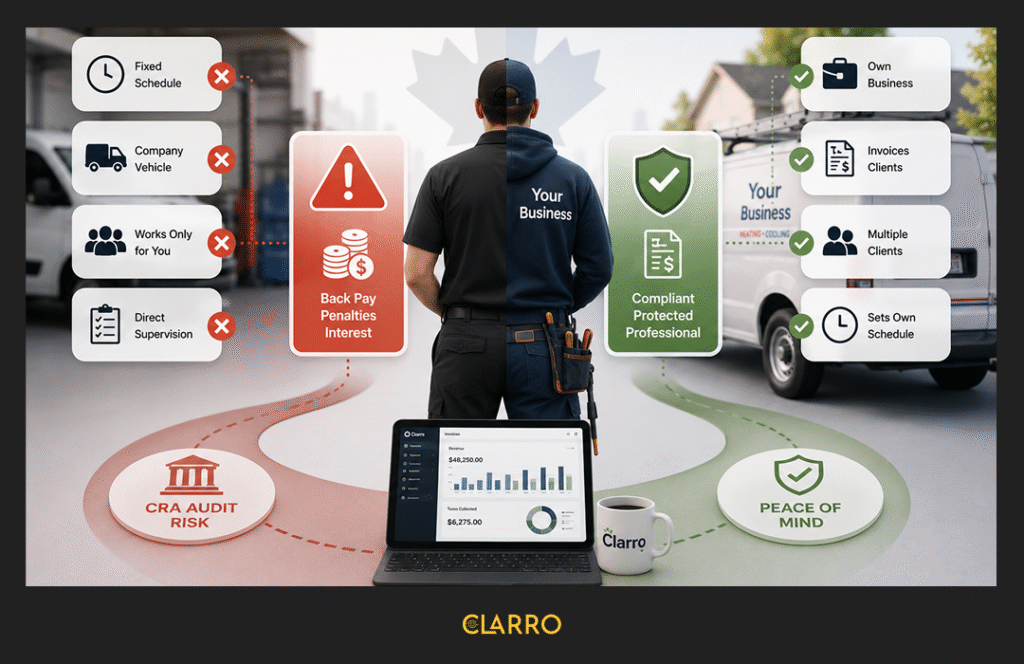
The CRA uses a four-factor test to determine the actual relationship:
- Control: Does your business control how and when the work is done, or just the outcome?
- Tools and equipment: Does the worker use your tools and vehicle, or their own?
- Chance of profit/risk of loss: Can the worker make more money by being more efficient, or are they simply paid by the hour regardless?
- Integration: Is this person integral to your business operations, or are they running their own independent business?
HVAC technicians are one of the most commonly misclassified workers in Canada. They often work exclusively for one company, use company vehicles, and follow company schedules, but are paid as contractors. Plumbers who work set hours under direct supervision face the same issue.
If the CRA reclassifies your subcontractors as employees, you become liable for all back CPP and EI contributions, both the employee and employer portions, plus interest and penalties. That can reach back several years and represent a significant financial hit.
The practical protection is having independent contractors sign a clear services agreement, ensuring they have their own business registration, invoice you for their services, and genuinely work for multiple clients. If someone only works for you, looks like an employee, and acts like an employee, the CRA will treat them as one.
As your business scales and the employee/subcontractor question becomes more complex, this guide on scaling a service business without losing control addresses how operational systems help you manage compliance at growth.
Recurring Service Plans and Subscription Billing: GST/HST Rules That Apply
Cleaning companies, lawn care businesses, HVAC maintenance providers, and pest control operators increasingly sell recurring service plans, monthly or seasonal contracts where clients pay a fixed amount on a regular schedule. This model is excellent for cash flow predictability, but it introduces specific compliance questions that almost no tax guide addresses.
Is each recurring payment a new taxable supply?
Yes. In Canada, each billing cycle under a recurring service agreement is generally treated as a separate taxable supply for GST/HST purposes. That means each monthly invoice must:
- Include the current GST/HST rate for the client’s province
- Show the correct BN and tax amount
- Be issued and retained as a standalone document
Rate changes and provincial moves
If a client moves provinces between billing cycles, not common, but it happens, the rate that applies changes with them. Your billing system needs to reflect the current rate at the time of each invoice, not the rate that applied when the contract was originally signed.
Auto-billing compliance
When you set up auto-billing, the system charges your client’s card each month, but you still need to generate a compliant invoice for each transaction. A charge appearing on a credit card statement is not a CRA-compliant receipt. Clients who are themselves registered businesses may need that invoice to claim their own ITCs.
Recurring service plans managed through field service software automatically generate a CRA-compliant invoice for each billing cycle, apply the correct provincial tax rate, and maintain the full transaction history, so neither you nor your client needs to chase documentation at tax time. Seasonal lawn care businesses and monthly cleaning companies are two of the strongest use cases for this kind of automated recurring billing with built-in tax compliance.
The CRA Deadlines That Cost Canadian Service Businesses the Most
Missing a CRA deadline is expensive. The late-filing penalty for GST/HST is 1% of the balance owing, plus 25% of that 1% for each full month it’s late, up to 12 months. For payroll, failure to remit on time can trigger penalties between 3% and 10% of the amount owed, with repeat offences reaching 20%.
Here are the key dates every Canadian service business needs to track:
GST/HST Filing Periods
| Annual Revenue | Assigned Filing Frequency |
| $1.5M or less | Annual (can request quarterly or monthly) |
| $1.5M – $6M | Quarterly |
| Over $6M | Monthly |
Note: As of January 1, 2024, all GST/HST registrants (except charities and select financial institutions) must file electronically; the old paper option for smaller filers no longer applies.
Payroll Remittance
If you have employees, CPP and EI deductions plus your employer contributions are due on the 15th of the month following the pay period. So if you pay salaries in January, your remittance is due February 15th. Miss it twice, and CRA can escalate to an accelerated remittance schedule.
Staying on top of it
The CRA’s My Business Account portal lets you view all your account balances, file GST/HST returns, set up pre-authorised debit payments, and receive correspondence digitally. It’s the fastest way to confirm a remittance was received and avoid disputes about whether a payment was made on time. For service businesses managing field teams across multiple sites, a mobile app development solution can surface deadline alerts, remittance summaries, and payment status directly in the hands of whoever owns the books, without needing to log into a desktop portal at all.
How Field Service Software Automates Compliance End-to-End
Here’s the truth about compliance for service businesses: it’s not that any individual step is complicated. It’s that there are a lot of steps, they happen constantly, and the consequences of missing one compound over time.
Manual compliance, building invoices in Word, recording payments in a spreadsheet, exporting data to your accountant at year-end, works until it doesn’t. The moment your team grows past a couple of technicians, the gaps start appearing. An invoice has not been sent. A payment was not recorded. A cash job that never made it into the books.
This is exactly the problem that field service management software in Canada is built to solve, not just scheduling and dispatching, but the full financial and compliance workflow that runs alongside every job.
Here’s what an automated compliance workflow actually looks like:
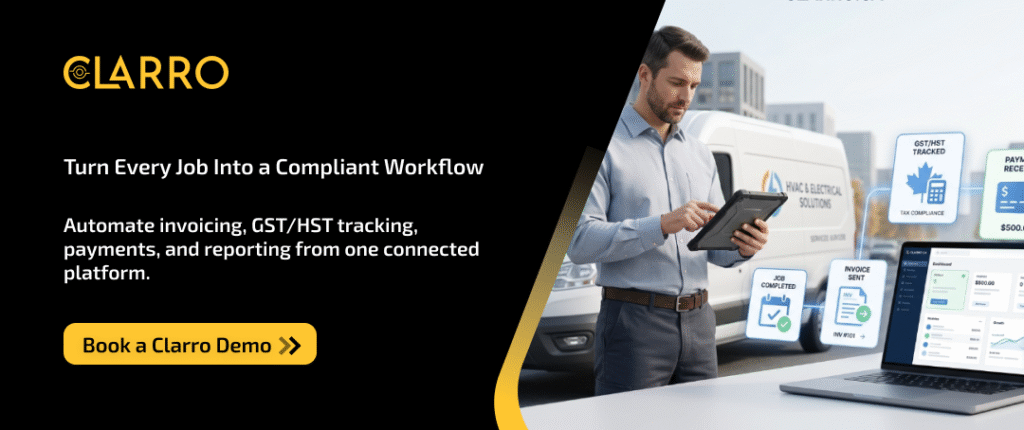
Job completed → invoice auto-generated with your BN, the correct provincial GST/HST rate for that client’s location, and a unique sequential invoice number. No manual entry, no rate lookup, no missed fields.
Payment collected on-site via card, e-transfer link, or tap-to-pay, directly from the technician’s phone. The payment is recorded against the invoice automatically, with a timestamp and payment method logged for audit purposes.
QuickBooks integration syncs invoices, payments, and tax data in real time. Your accountant sees the same numbers you do, without waiting for an end-of-month export.
Cash flow stays healthy even between jobs and remittance cycles. Instead of waiting for client cheques or bank transfers to clear, same-day access to completed-job revenue means you’re not dipping into operating funds to cover a GST remittance that’s due before your next invoice pays out.
Tax reports are ready when you need them. At remittance time, you’re not spending a weekend reconciling invoices; you pull a report, verify the numbers, and file.
For larger jobs where clients need payment flexibility, consumer financing options let clients pay over time while you receive the full amount upfront, improving your cash position without creating outstanding receivables or compliance gaps.
This end-to-end workflow is what separates service businesses that scale cleanly from those that hit a wall of administrative complexity at 10 or 15 employees. The compliance doesn’t get easier as you grow, but the right software means it doesn’t have to get harder either.
When your business needs a custom-built solution
Off-the-shelf field service software works well for most service businesses. But there’s a point, usually when you’re running a multi-province operation, managing a franchise model, or building a platform where other service providers operate under your brand, where the standard product no longer fits the way your business actually works.
At that stage, the gap isn’t just a feature request. It’s compliance logic that doesn’t match your structure, tax rules hardcoded for a different market, or a workflow that requires your team to work around the software instead of with it.
This is where custom software development becomes the practical option. A purpose-built system can embed your exact invoicing rules, provincial tax logic, and CRA reporting requirements directly into the product, so compliance isn’t a layer you add on top; it’s built into every transaction from the start.
For service businesses with field teams that need compliance tools available without a laptop or desktop login, a custom mobile app can put job completion, invoice generation, GST/HST calculation, and payment collection into a single tool your technicians carry in their pocket, connected to your back-office systems in real time.
Whether you start with a platform like this one and grow into a custom build, or you’re ready to build from scratch, the underlying goal is the same: a system where compliance happens automatically at the point of every transaction, not as a catch-up exercise at the end of every quarter.
Final Thoughts
Small business taxes in Canada don’t have to be a part of running a service business that keeps you up at night. The rules are clear, the deadlines are predictable, and the tools to handle it automatically are better than they’ve ever been.
Register for GST/HST when you hit the threshold. Invoice every job correctly with your BN and the right tax rate. Document every payment, card, e-transfer, and cash, and make sure your records are retained for six years. Understand whether the people working for you are employees or genuine subcontractors. And use software that does the calculation, the documentation, and the reporting for you.
If you’re building the operational foundation of a service business that scales without compliance becoming a liability, this overview of service business management software is a good next read. It covers how the right platform connects scheduling, payments, invoicing, and reporting into one system that keeps you CRA-ready every day of the year.
Related Read
Now that you know how Canadian service business taxes work, the next step is making sure your day-to-day operations are just as tight.
Read next: Service Management Software for Small Businesses: Save Time & Reduce Errors →
Learn how Canadian service businesses are cutting admin hours, reducing billing errors, and managing jobs, invoices, and payments from one platform.
Frequently Asked Questions
1. When does a Canadian service business need to register for GST/HST?
Most service businesses in Canada must register for GST/HST once total taxable revenue exceeds $30,000 over four consecutive calendar quarters. Many businesses also register earlier to claim Input Tax Credits (ITCs) on expenses like fuel, software, tools, and equipment.
2. What should a CRA-compliant invoice include in Canada?
A CRA-compliant invoice should include your legal business name, GST/HST number, invoice date, unique invoice number, customer details, service description, subtotal, tax amount, and total payable. Proper invoicing is essential for CRA compliance and accurate tax reporting.
3. How can field service businesses simplify tax and compliance management?
Using Clarro helps automate invoicing, GST/HST calculations, payment tracking, reporting, and job management from one platform. This reduces manual errors and helps service businesses stay CRA-ready year-round.
4. Are e-Transfers and cash payments acceptable for CRA reporting?
Yes, but every payment method must be properly documented. Cash payments should always include receipts and bookkeeping records, while e-Transfers should be matched to invoices to maintain accurate CRA-compliant financial records.
5. What is the best software for managing payments, invoicing, and compliance for Canadian service businesses?
Many Canadian businesses now use all-in-one field service management software like Clarro to manage scheduling, invoicing, payment collection, GST/HST tracking, recurring billing, and reporting from a single dashboard.